
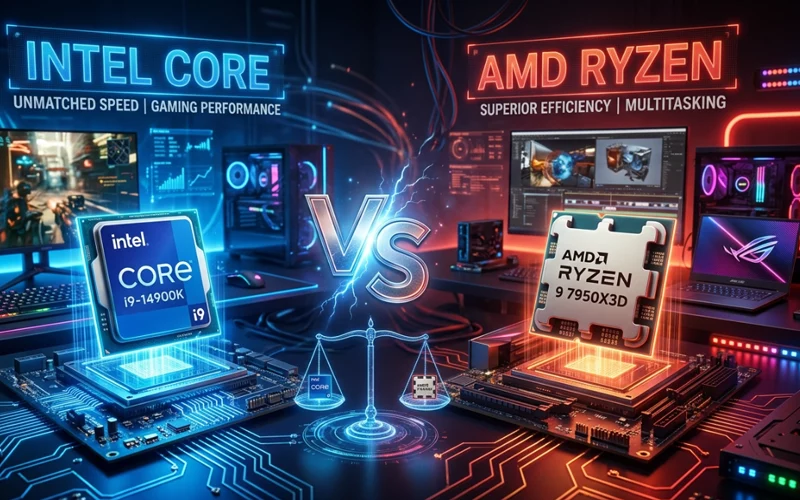
Choosing a processor can feel confusing because both Intel and AMD make strong chips, and both have models for different kinds of users. Some people want the best performance for gaming, some want a laptop that stays cool and lasts longer on battery, and some need a system for editing, study, work, or everyday use. That’s why the intel vs amd comparison is still so important today. The right choice is not always about brand name. It depends on what you do, how much you spend, and what kind of experience you want from your computer.
This guide breaks down the differences in a simple and easy-to-understand way. By the end, you will understand where Intel usually stands out, where AMD often shines, and how to choose the best option without getting lost in technical terms.
Why CPU Choice Matters More Than You Think
The processor acts as the computer’s central control unit, handling all instructions and operations. It manages all instructions, opens applications, runs games, processes files, and handles multiple tasks at the same time. A weak CPU can make even a good computer feel slow. A powerful CPU can keep everyday tasks running smooth and responsive, even when the rest of the system is built on a budget.
People often ask which is better intel or amd because they want a simple answer. The real answer actually depends on how you plan to use it. A person who plays competitive games may need different features than someone who edits large videos or just watches Netflix, writes documents, and browses the web. That is why the best CPU is not the same for every person.
When comparing intel vs amd cpu, it helps to focus on real-world use instead of only looking at numbers on a spec sheet. Benchmarks matter, but comfort, temperature, battery life, and price also matter in daily life.
Gaming Performance: What Matters
For many buyers, gaming is the first reason they compare processors. They want high FPS, smooth gameplay, and less lag. In this area, the discussion around intel vs amd for gaming has become more balanced over time. Both companies now produce high-performance gaming CPUs, and in most situations the gap between them is minimal unless you’re aiming for extreme, competitive-level gaming.
A gaming processor should not only be fast in theory. It should also support the graphics card well, keep frame times steady, and avoid bottlenecks. Some games prefer higher single-core speed, while others can use more cores effectively. That is why one CPU may perform better in one game and another may win in a different title.
If you are wondering which cpu is better for gaming, the answer is usually the one that gives the best mix of performance and value in your budget. Sometimes Intel offers slightly stronger results in certain games. Sometimes AMD can deliver better efficiency and also a more cost-effective price for the same level of performance. The GPU also matters a lot, so a balanced system is more important than buying the most expensive processor alone.
For most gamers, the smart approach is simple: choose a CPU that is strong enough to support your graphics card and your target resolution. If you play at 1080p and want very high frame rates, CPU performance becomes more important. If you play at 1440p or 4K, the graphics card usually matters more than tiny differences between processors.
Intel vs Ryzen in everyday use
The comparison intel vs ryzen is popular because Ryzen has become AMD’s well-known desktop and laptop CPU line, and it is often used as the main AMD reference point. In daily use, both Intel and Ryzen systems can feel fast, responsive, and smooth. Opening apps, switching tabs, video calls, office work, and light creative tasks are all handled well by both sides.
Where users notice a difference is in specific behavior. Some Intel chips may feel stronger in short bursts and certain productivity tasks. Some Ryzen chips may offer excellent efficiency and strong multi-tasking, especially in value-focused setups. For many people, the better choice is the one that gives the right balance of speed, heat control, and price.
If you are building a new desktop, the platform matters too. Motherboard options, upgrade path, memory support, and cooling can change the final experience. So while intel vs ryzen is a useful comparison, it should be only one part of the decision.
Laptop choice: battery, heat, and comfort
Laptops are different from desktops because power use and heat matter even more. A laptop CPU must perform well without draining the battery too fast or making the device too hot to use comfortably. That is why amd vs intel laptop searches are so common. People are not only asking about speed. They are asking about real-life convenience.
Intel laptops are often praised for wide availability and strong performance in many thin-and-light machines. AMD laptops are often liked for efficiency, battery life, and good integrated graphics in many models. However, the overall performance is influenced more by the laptop’s design and cooling system than just the processor brand it uses. Two laptops with the same processor can still feel very different because of cooling, screen quality, battery size, and build quality.
This is why you should not choose a laptop only by reading the processor name. A well-designed AMD laptop can be better than a poorly designed Intel one, and the reverse is also true. The best laptop is the one that stays cool, lasts long enough for your day, and gives you the performance you need without forcing you to keep the charger close all the time.
Power efficiency and heat management
A big reason people compare intel vs amd power consumption is that energy use directly influences battery life, fan noise, heat levels, and overall comfort during long use. A processor that uses less power often runs cooler and can be quieter. That matters a lot in slim laptops and compact desktop builds.
AMD has often been known for strong efficiency, especially in many laptop and mainstream desktop chips. Intel has also improved a lot in efficiency over the years, and many of its newer processors are much better balanced than older generations. The important thing is that power use is not just about the chip. Cooling design, workload type, and system tuning all play a role.
If you work on a laptop for many hours, power efficiency may matter more than a small speed difference. A cooler system feels better to use, drains less battery, and often performs more consistently under load. In that sense, intel vs amd power consumption is not a tiny detail. It can change your everyday experience in a big way.
Video Editing, Content & Heavy Workloads
For editing videos, rendering projects, encoding files, and working in creative software, processor choice becomes more serious. Many people search intel vs amd for video editing because they want a CPU that handles large tasks without slowing down. In this area, core count, multi-thread performance, cooling, and software optimization all matter.
Some editing programs work very well with Intel, especially when certain media engines or acceleration features are used. AMD can also be excellent for editing, especially in CPUs with strong multi-core performance. If your workflow includes 4K editing, motion graphics, and large exports, the CPU should not be chosen only by brand. You should think about how your software behaves, how much RAM you have, and whether your GPU also helps with editing tasks.
For simple edits, both Intel and AMD are more than capable. For heavier work, you should look for a CPU that stays strong under long loads rather than one that only looks good in short benchmark tests. That is often where the best value choice appears.
Value, upgrades, and long-term use
A processor is not just a one-time purchase. It affects the life of your system for years. This is why value matters so much in the intel vs amd discussion. A CPU that costs a little less but gives similar performance can free up money for a better GPU, more RAM, or a faster SSD. That can improve the whole computer more than spending everything on the processor.
Upgrade path is another important factor. Some users like to keep the same motherboard and upgrade the CPU later. Others prefer to buy a strong system once and use it for years. Platform support can change over time, so it is smart to think beyond today’s performance. A good processor should fit your future needs as well as your current ones.
When people ask which is better intel or amd, they often expect one winner for everyone. But in reality, the better brand changes depending on the deal, the generation, and the machine type. Sometimes AMD gives better value. Sometimes Intel has the better package. The smartest buyer checks the full system, not just the processor label.
What kind of user should choose what
That is the real lesson behind the intel vs amd debate. There is no single answer that fits every person. A student, a video editor, a casual user, and a competitive gamer all care about different things. The best processor for one person may be a poor match for another.
The safest method is simple. Start by identifying what you spend most of your time doing. Then set your budget. After that, compare a few actual laptops or desktops instead of comparing only brand names. A well-matched system will feel much better than a flashy one with the wrong parts.
Which CPU Should You Choose?
Intel and AMD are both strong choices, but they are better suited for different types of users. There is no single “best” option for everyone.
If you are a competitive gamer who needs high FPS, low latency, and strong single-core performance, or you want a system that feels very responsive in most everyday tasks, then Intel is often a better fit. Intel processors usually perform very well in gaming scenarios where fast per-core speed matters.
If you care more about battery life, lower heat, and efficient multitasking, then AMD is usually the better choice. AMD processors are known for better power efficiency, especially in laptops, and they often provide stronger multi-core performance at the same price range.
For content creators and video editors, both are capable, but AMD can have an advantage in heavy multitasking and long rendering tasks due to higher core and thread performance. On the other hand, Intel can feel smoother in certain optimized software and fast-paced editing workflows.
FAQs:
Which is better for gaming, Intel or AMD?
Both are excellent for gaming. AMD often gives better value and strong performance in modern titles, while Intel can deliver higher FPS in some competitive games depending on the model.
Is AMD better than Intel for laptops?
Not always. AMD laptops usually offer better battery life and efficiency, while Intel laptops often provide strong overall performance and wide availability.
Which CPU is better for general use?
For everyday tasks like browsing, office work, and streaming, both Intel and AMD work well. Intel often feels slightly more responsive in basic tasks, while AMD is more power-efficient.
Does AMD use less power than Intel?
In many cases, yes. AMD processors are generally known for better power efficiency, especially in laptops, but it depends on the exact generation and model.
Which is better for video editing, Intel or AMD?
Both are good. AMD often performs better in heavy multitasking and long rendering due to more cores, while Intel can be faster in some optimized editing software.
Is Intel more expensive than AMD?
Not always. Pricing depends on the model and generation. Sometimes AMD offers better performance for the price, and sometimes Intel does.
Which CPU is better for multitasking?
AMD usually has an advantage in multitasking because many of its CPUs offer more cores and threads at similar price points.
Can I use AMD or Intel for gaming and work together?
Yes. Both CPUs can handle gaming and productivity tasks easily. The difference comes down to performance level, not compatibility.
Does the brand matter more than laptop design?
No. Laptop design, cooling, and power management are often more important than just the CPU brand inside.
Which should I buy in 2026, Intel or AMD?
Choose based on your needs. AMD is great for value and efficiency, while Intel is strong for consistent performance and responsiveness.
Simply put:
Choose Intel if your focus is gaming performance and fast general responsiveness. Choose AMD if you want better efficiency, longer battery life, and stronger value for money.
In the end, the right choice depends on your usage, not just the brand name.
If you want to read more interesting and detailed guides, visit EmbossitWorld now. You’ll find useful Information, and a lot of practical information. Don’t miss out.





Add comment