
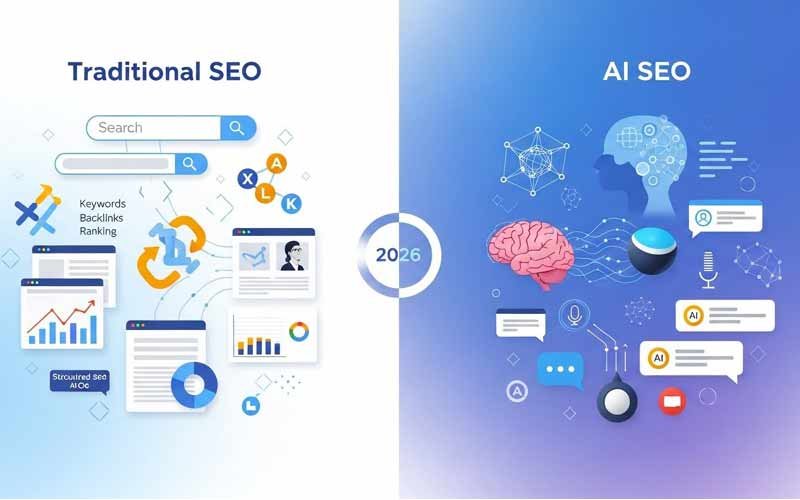
Traditional SEO vs AI SEO: The Complete Guide for 2026
In today’s online world, just having a website is not enough. You can have the most beautiful website, with amazing design and content, but if no one can find it online, it will not serve its purpose. This is where Traditional SEO vs AI SEO comes into play.
SEO, which stands for Search Engine Optimization, is a process that helps your website appear in search results. It makes sure that people can find your site, visit it, and become your customers. For many years, Traditional SEO or Google SEO was the main way to get noticed online. But with the rise of AI tools and AI-driven searches, AI SEO is now becoming equally important. Both aim for visibility, but they work in very different ways.
In this guide, we will explain everything in simple terms, covering all the details so anyone can understand how to use both Traditional SEO and AI SEO effectively.
What is Traditional SEO?
Traditional SEO, also known as Google SEO, is the classic way to rank a website in search engine results. It focuses on optimizing your website so that it appears higher on Google when users search for something related to your content.
The main goal of Traditional SEO is to get more people to visit your website. The more visitors you get, the higher the chance of generating leads, sales, or any other business goal.
Key Components of Traditional SEO
Keyword Research
Keywords are the words or phrases people type into search engines. For example, if you have a food blog, people might search for “best biryani recipe” or “easy chicken recipes.” Finding the right keywords is essential because using them correctly on your website helps Google understand what your page is about.
- Short-tail keywords: Simple, one or two words (e.g., “biryani”).
- Long-tail keywords: Longer phrases (e.g., “how to make spicy chicken biryani at home”). These are more specific and easier to rank for.
On-Page SEO
On-page SEO includes everything you do on your website to improve ranking:
- Title Tags: The title that shows up on Google results. It should include your main keyword.
- Meta Descriptions: Short summary of your page. It encourages people to click.
- Headings (H1, H2, H3…): Helps Google understand the structure of your content.
- Content: Must be useful, original, and high-quality.
Off-Page SEO
Off-page SEO focuses on building your website’s authority outside your site:
- Backlinks: Links from other websites to yours. High-quality backlinks improve trust and ranking.
- Social Signals: Shares, likes, and mentions on social media can indirectly help SEO.
Technical SEO
This deals with how your website works behind the scenes:
- Site Speed: Faster websites rank better.
- Mobile-Friendliness: Google prefers mobile-optimized websites.
- Secure Website (HTTPS): Safety matters for ranking.
Example: If someone searches “best biryani recipe,” Traditional SEO ensures your article appears on the first page of Google. This increases the chance of clicks and visitors.
In short: Traditional SEO is all about increasing traffic, getting clicks, and building website authority.
What is AI SEO?
AI SEO is a newer approach that works differently. Instead of focusing mainly on clicks, it focuses on making your content easy for AI systems to read, understand, and use.
With AI tools like ChatGPT, AI-powered Google search answers, and voice assistants, people often get answers without visiting your website. AI SEO ensures that your content is recognized and used by these systems.
Key Components of AI SEO
- Clear and Simple Content
AI systems prefer content that is easy to understand. Using short sentences, clear headings, bullet points, and structured information makes your content more readable for AI. - Direct Answers to Questions
People often ask questions like “How to cook biryani?” or “What are the benefits of meditation?” AI looks for content that directly answers these questions without unnecessary information. - Context and Relevance
AI SEO ensures that your content is organized logically, with relevant context. This increases the chance that AI tools will use your content in their answers. - Structured Content
Using headings, numbered lists, bullet points, and FAQs helps AI systems identify the main points quickly.
In short: AI SEO is not about clicks or website visits. Its goal is to make your content understandable and usable by AI systems so it can appear in AI-generated answers or summaries.
Traditional SEO vs AI SEO: Key Differences
| Feature | Traditional SEO | AI SEO |
| Goal | Increase website traffic | Make AI systems use your content |
| Focus | Keywords, backlinks, meta tags | Clarity, structure, context, direct answers |
| Content Style | Keyword-focused, optimized for clicks | Simple, easy to read, conversational |
| Measurement | Ranking, click-through rate, traffic | AI references, AI summaries, voice answer inclusion |
Why Both Are Important
Many people think AI SEO will replace Traditional SEO. This is not true.
- Traditional SEO still drives the majority of website traffic. People still click on Google search results every day.
- AI SEO ensures your content is visible to AI tools and voice assistants, which are becoming increasingly common.
The best strategy is to use both together. By combining Traditional SEO and AI SEO, you can reach more users, whether they search on Google or ask an AI assistant.
How to Optimize for Both Traditional and AI SEO
Here is a step-by-step guide to making your content effective for both Google and AI:
- Understand User Intent
- Don’t just focus on keywords. Think about what the user wants.
- Example: If someone searches “how to cook biryani,” give a full, step-by-step answer.
- Use Clear Structure
- Use headings (H1, H2, H3) to organize sections.
- Add bullet points, numbered lists, and tables.
- Include FAQs to answer common questions.
- Write High-Quality Content
- Make it accurate, helpful, and easy to read.
- Avoid fluff or filler content.
- Use Structured Data
- Schema markup helps AI understand your content better.
- It can improve your chances of appearing in AI-generated answers or rich results.
- Monitor Performance
- Track Google traffic, clicks, and rankings.
- Check how your content is used in AI tools.
- Adjust based on results.
- Optimize for Mobile and Speed
- Both Google and AI prefer fast, mobile-friendly websites.
Practical Tips for Content Writing in 2026
- Focus on Questions
- Think like your audience: what are they asking?
- Provide clear, step-by-step solutions.
- Write in a Conversational Tone
- AI SEO likes simple, natural language.
- Traditional SEO can use keywords, but keep it readable.
- Use Examples and Stories
- Real-life examples make your content more engaging.
- AI and humans both like structured examples.
- Combine Keywords and Natural Language
- Include keywords for Google.
- Use plain language for AI comprehension.
- Update Your Content Regularly
- Both AI and Google prefer fresh and accurate content.
Examples of AI-Friendly Content
- Step-by-Step Guides: “How to bake chocolate cake in 5 easy steps.”
- Lists: “Top 10 tips for healthy eating.”
- FAQs: “What is SEO? How does it work?”
- Tables and Charts: Organize information for better understanding.
These formats make it easier for AI to pick up your content for direct answers.
- Traditional SEO helps people find your website through search engines.
- AI SEO helps AI systems understand your content and use it in answers.
In 2026, both are essential. Traditional SEO builds the foundation for traffic, while AI SEO ensures your content remains relevant as AI-driven searches become more common.
Websites that master both reach more users, provide better value, and stay ahead of competitors. By following these strategies, your content will not only attract visitors but also gain credibility in AI systems.
FAQs
1. What is the main difference between Traditional SEO and AI SEO?
Traditional SEO focuses on ranking your website higher on Google to get more clicks and traffic. AI SEO focuses on making your content easy for AI systems to understand and use in direct answers, summaries, or voice search results. One is click-based, the other is answer-based.
2. Is Traditional SEO still important in 2026?
Yes, Traditional SEO is still very important in 2026. Most people still search on Google and click on websites. Traditional SEO helps bring traffic, build trust, and increase sales. AI SEO is growing, but it has not replaced Traditional SEO.
3. What is AI SEO and why is it growing so fast?
AI SEO is the process of optimizing content so AI tools like ChatGPT, voice assistants, and AI-powered search results can easily understand and use it. It is growing fast because many users now want instant answers instead of clicking multiple websites.
4. Can AI SEO replace Google SEO completely?
No, AI SEO cannot completely replace Google SEO. AI SEO helps with visibility in AI answers, while Google SEO helps with website traffic and long-term authority. The best strategy is to use both together instead of choosing only one.
5. How can I optimize my content for both Traditional SEO and AI SEO?
You can optimize for both by using clear headings, answering user questions directly, adding FAQs, using keywords naturally, and writing simple, structured content. Fast loading speed and mobile-friendly design also help both Google and AI systems.
6. Does keyword research still matter for AI SEO?
Yes, keyword research still matters, but the approach is different. Instead of stuffing keywords, focus on user intent and natural language. AI prefers clear answers and context, while Google still uses keywords to understand topic relevance.
7. What type of content works best for AI SEO?
AI SEO works best with structured content like step-by-step guides, FAQs, lists, tables, and clear explanations. Content that answers common questions in simple language has a higher chance of being used in AI-generated responses.
8. Why should businesses combine Traditional SEO and AI SEO in 2026?
Businesses should combine both because users search in different ways. Some click Google results, while others use AI tools or voice search. Using both strategies helps reach more people, increase visibility, and stay competitive in the future.





Add comment