
Introduction
YouTube has become a major part of everyday internet use. People visit the platform to watch music videos, learn new skills, follow creators, research products, enjoy entertainment, listen to podcasts, watch live streams, and discover useful information. Because of this wide range of activities, many people are unsure how YouTube should actually be classified. One of the most common questions searched online is is youtube social media, especially among beginners who want to understand the difference between social platforms, streaming services, and video websites.
Some people think of it as a video-sharing website, while others see it as a streaming service or even a search engine for videos. At the same time, YouTube has comments, subscriptions, likes, shares, creator channels, communities, and other interactive features that are normally associated with social networking websites.
The simple answer is yes, YouTube can be considered social media. However, that answer does not tell the complete story. YouTube is a multi-purpose platform that combines video sharing with search, streaming, entertainment, education, and social interaction. Understanding these different functions helps explain why YouTube is different from platforms such as Facebook, Instagram, and TikTok.
What Is YouTube?
YouTube is an online video platform where people can watch, upload, share, and discover video content. It allows individuals, businesses, organizations, educators, musicians, and professional creators to publish videos for audiences around the world.
The platform contains almost every type of video imaginable. Users can find tutorials, product reviews, documentaries, interviews, educational lessons, gaming videos, music, comedy, news, podcasts, live broadcasts, and short-form content.
One of the most important features of YouTube is its creator system. Users can create channels and publish their own videos instead of simply consuming content made by large media companies. Viewers can subscribe to these channels and continue following the creators they enjoy.
This creates an ongoing relationship between the person producing the content and the people watching it. That relationship is one of the main reasons YouTube has a strong social element. It is also an important reason why the question is youtube social media has become common among people researching the platform’s purpose.
What Does Social Media Mean?
Social media generally refers to online platforms that allow people to create, share, discover, and interact with content and other users. Different platforms may focus on different activities, but interaction and user participation are usually important parts of the experience.
For example, Facebook focuses heavily on social connections, groups, pages, and personal updates. Instagram is strongly associated with photos, videos, creators, and visual content. TikTok focuses heavily on short-form videos and rapid content discovery. Reddit is built around communities and discussions.
Social media does not have to look the same on every platform. A website can have a different primary purpose while still providing social features.
This is important when looking at YouTube because video is the center of the platform, but social interaction happens around that video content. When these characteristics are considered together, is youtube social media becomes less difficult to answer.
Why YouTube Fits Into the Social Media Category
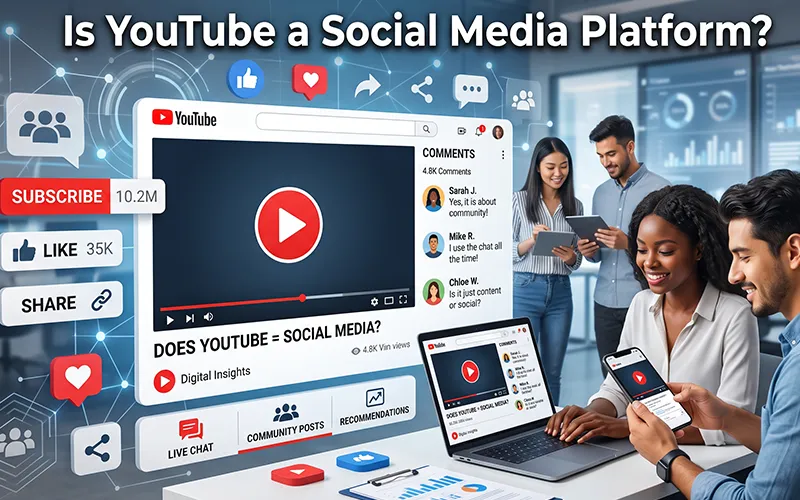
YouTube has many features that are commonly found on social platforms. Users can create public channels, publish their own content, subscribe to other creators, leave comments, like videos, share content, and participate in discussions.
A creator can upload a video and receive feedback from viewers. Viewers can ask questions in the comments, recommend ideas for future videos, and share the content with friends. The creator can then respond to that audience and create additional content based on their interests.
This creates a two-way relationship rather than a simple one-way broadcast.
Traditional television is mainly designed around a broadcaster sending content to viewers. YouTube gives viewers opportunities to respond, participate, and become creators themselves.
That difference is significant when discussing whether the platform belongs to the social media category. It also explains why many digital marketers classify YouTube alongside other major social platforms when planning content strategies.
User-Generated Content
User-generated content is one of the strongest characteristics of modern social platforms, and YouTube is heavily based on it.
Anyone who has access to the necessary account and follows the platform’s rules can create videos and publish them. These videos can be about personal experiences, education, technology, cooking, travel, gaming, entertainment, business, or almost any other suitable topic.
A creator does not need to be a large media company to reach an audience. A single person with useful knowledge and a smartphone can potentially create content that reaches thousands or even millions of viewers.
This democratization of video publishing has played a major role in YouTube’s growth and has helped create a huge global creator community.
User-generated content is also one of the strongest arguments supporting the idea that is youtube social media can be answered positively. The platform gives ordinary users a way to publish content and develop an audience instead of limiting publishing to professional organizations.
Comments and Audience Interaction
Comments are another feature that gives YouTube a social character. Viewers can respond to videos, ask questions, share opinions, and discuss the subject with other users.
Creators can also interact with their audiences through comments. A useful comment may lead to a direct response from the creator, while repeated questions can inspire future videos.
This type of interaction makes the experience more participatory. Viewers are not always passive consumers. They can influence discussions and sometimes influence what creators produce next.
For many channels, the comment section becomes an important part of the community surrounding the content.
This interaction is particularly useful for creators who want to build trust. When viewers feel that a creator listens to them and responds to their questions, the relationship can become stronger over time.
Subscriptions and Creator Communities
YouTube’s subscription system allows viewers to follow channels they enjoy. When people regularly subscribe to a creator, they become part of that channel’s audience.
Over time, this can develop into a community. Viewers may recognize other regular commenters, discuss new videos, share opinions, and return whenever the creator publishes something new.
Some creators also use community features to communicate with subscribers between video uploads. This helps maintain a connection even when there is no new long-form video.
The relationship between creators and subscribers is one of the clearest social aspects of the platform. It is another reason the classification of YouTube as social media makes sense.
Is YouTube Mainly Entertainment?
Entertainment is certainly one of YouTube’s biggest purposes. People use the platform to watch comedy, music, gaming, interviews, podcasts, movie-related content, live events, and many other forms of entertainment.
However, entertainment is only one part of the platform.
Millions of people also use YouTube to learn. Someone might watch a mathematics lesson, a software tutorial, a cooking guide, a fitness demonstration, or a repair video. Businesses may use it for product education, while students may use it as an additional learning resource.
This means the platform can be both entertainment-focused and information-focused depending on the user’s intention.
For this reason, the question is youtube social media or entertainment does not have to be treated as an either-or choice. YouTube can provide entertainment while also functioning as a social and educational platform.
How YouTube Combines Social Features With Video
The most interesting part of YouTube is how its social features work around video content.
Consider a technology creator who publishes a review of a new smartphone. Viewers can watch the review, leave comments, ask questions, share the video, subscribe to the channel, and recommend the content to others.
The creator can read this feedback and make another video answering common questions. This creates an ongoing conversation.
The video itself becomes the starting point for social interaction.
This is somewhat different from a platform where the social connection comes first. On YouTube, content often comes first and the community develops around that content.
This model is one of the reasons how is youtube social media is an interesting question. Its social nature is built around content rather than only personal relationships.
Is YouTube a Streaming Platform?
YouTube is also a streaming service because users receive video content over the internet rather than downloading an entire file before watching it.
The platform supports both recorded videos and live broadcasts. Live streaming allows creators and organizations to communicate with audiences in real time.
Viewers can participate through live chats and other interactive features while the broadcast is happening.
This shows that streaming and social media are not mutually exclusive categories. A service can deliver streaming content while also providing social interaction.
YouTube is a strong example of this combination. Therefore, is youtube social media or streaming is better understood as a question with more than one valid part of the answer.
Is YouTube a Search Engine?
YouTube also functions as a major search and discovery platform for video content.
People often open YouTube because they want to find a specific answer. They might search for instructions on using software, repairing a device, cooking a meal, learning a language, or choosing a product.
This is why the question is youtube social media or search engine can be confusing.
The best explanation is that YouTube has a search function that is especially powerful for video discovery, but it also has social features that allow people to interact with creators and communities.
A person can use YouTube as a search tool in one moment and as a social platform in another.
This combination gives the platform a unique position on the internet. It does not need to be limited to one category.
Can YouTube Be Used Without Posting?
Yes. A person does not have to upload videos to participate in the platform.
Many people use YouTube mainly as viewers. They watch videos, subscribe to channels, like content, leave comments, and share videos without ever creating a public video themselves.
This is similar to other social platforms. A large number of social media users rarely publish posts but still follow accounts, react to content, and participate in discussions.
Therefore, not creating content does not automatically make someone a non-user of social media.
This also answers is youtube social media if you don t post. You can participate through viewing, commenting, subscribing, liking, and sharing even when you never upload anything yourself.
Is YouTube a Social Media App?
The mobile application provides many of the same features as the website. Users can watch content, search for videos, subscribe to channels, comment, like, share, and upload videos.
The mobile format has made video consumption more convenient and has encouraged people to use YouTube throughout the day.
Creators can also manage their channels from mobile devices, respond to viewers, check performance information, and upload content.
Because of these features, the mobile experience supports both content consumption and social interaction.
For this reason, is youtube social media app is a relevant search query for people trying to understand the role of YouTube on mobile devices.
What Is YouTube Used For?
People use YouTube for a wide variety of purposes.
Education is one of the most important uses. Students and professionals can find lessons, tutorials, demonstrations, lectures, and explanations.
Entertainment is another major category. Music, gaming, comedy, interviews, podcasts, and other content attract huge audiences.
Businesses use YouTube to demonstrate products, answer customer questions, explain services, and build brand awareness.
Creators use the platform to share their skills, opinions, experiences, and creative work.
This variety means the platform has value for almost every type of internet user.
A person might use it for entertainment in the evening and then use it for learning or research the next morning. The same account can support completely different activities.
Challenges of the Platform
YouTube also has challenges. Creating quality video content can take considerable time and effort.
Depending on the content, creators may need recording equipment, editing software, good thumbnails, scripts, research, and regular publishing schedules.
Competition is another major challenge. There are millions of creators producing videos, so gaining attention can take patience and consistency.
Creators also need to understand their audience. Publishing random content without a clear purpose can make it difficult to develop a loyal viewer base.
These challenges are important for anyone planning to use YouTube professionally.
Another challenge is maintaining audience attention. Because viewers have countless videos to choose from, creators need useful, engaging, and relevant content to encourage people to keep watching.
Why Classification Can Be Confusing
The reason people disagree about YouTube’s category is simple: modern internet platforms often perform several jobs at once.
A person watching a music video may see YouTube as entertainment. Someone searching for a computer tutorial may see it as a search tool. A creator communicating with subscribers may see it as social media. Someone watching a live broadcast may see it as a streaming service.
None of these experiences is necessarily wrong.
Instead of forcing YouTube into one category, it is more useful to understand that the platform combines several digital functions.
This also explains why is youtube social media definition searches can produce different explanations. The definition depends on which characteristics someone uses to classify a platform.
If social media means a website where users create, share, and interact with content and communities, YouTube clearly fits. If someone uses a narrower definition based mainly on personal networking, they may describe YouTube primarily as a video platform.
Frequently Asked Questions
1. Is YouTube considered a social media platform?
Yes. YouTube is commonly included in the wider social media category because users can create content, interact with audiences, subscribe to creators, comment, share videos, and participate in communities.
2. Can someone use YouTube as social media without uploading videos?
Yes. Watching videos, subscribing to channels, commenting, liking, and sharing content are all forms of participation. You do not need to become a creator.
3. Is YouTube a streaming service?
Yes. YouTube delivers recorded videos and live broadcasts through internet streaming. Its streaming function exists alongside its social and community features.
4. Is YouTube a search engine?
YouTube has a powerful search and discovery system, particularly for video content. However, it is not a general web search engine like Google Search.
5. Is YouTube similar to Facebook?
They share several social features, including content sharing, interaction, profiles, and communities. Facebook is more broadly focused on social networking, while YouTube is primarily centered around video.
6. Is YouTube similar to TikTok?
Both platforms support video creation, discovery, sharing, and audience interaction. TikTok is particularly focused on short-form videos, while YouTube supports short and long-form content as well as live streams.
7. Why do some people call YouTube a video-sharing platform instead?
Video sharing is the platform’s central function, so this description is accurate. However, it does not cover the comments, subscriptions, communities, and creator-audience relationships that give YouTube its social side.
8. Is YouTube mainly used for entertainment?
Entertainment is one of its biggest uses, but the platform is also widely used for education, tutorials, product research, marketing, music, news, gaming, and communication.
Final Verdict
If you want to read more interesting and detailed guides, visit EmbossitWorld now. You’ll find useful Information, and a lot of practical information. Don’t miss out.




Add comment