
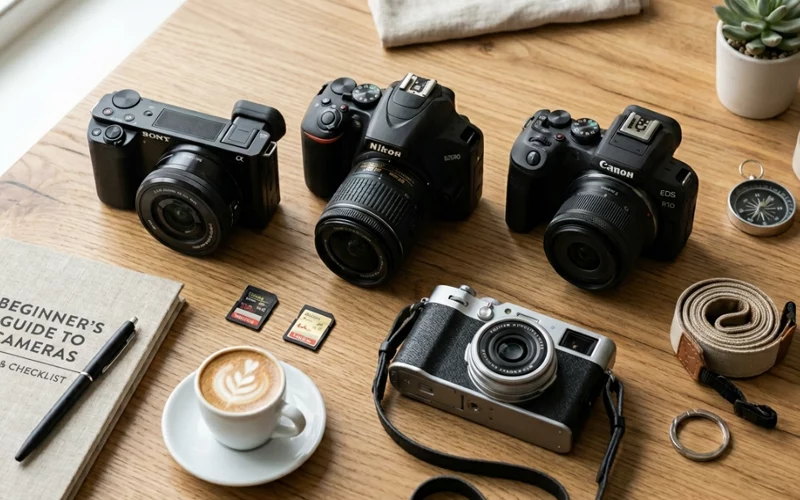
Choosing your first camera can feel exciting and overwhelming at the same time. There are so many options: different brands, sizes, features, and price ranges. This guide makes the choice easier by explaining the main camera types, the features that matter most, and the models that are worth considering. By the end, you will have a clear idea of what to look for in the best camera for beginners.
When choosing a beginner camera, think about how you plan to use it. Travel photography, family photos, street shooting, and YouTube all require slightly different features. Some cameras are better for still photos, while others are stronger for video and vlogging. Comfort also matters, because a camera that feels good in your hands is more likely to be used often.
A common myth is that beginner cameras cannot produce high-quality results. In reality, many entry-level models offer excellent image sensors, fast autofocus, and even 4K video. Cameras such as the Canon EOS R10, Canon EOS R100, Sony A6400, and Nikon Z50 II show how much performance beginner-friendly models can offer today.
Which Beginner Camera Should You Choose?
Before picking a model, it helps to understand the three main camera types available for beginners.
Mirrorless cameras: These are modern cameras without an internal mirror mechanism. They are usually lighter and more compact than DSLRs, and they often offer strong autofocus and better video features. Good beginner-friendly mirrorless options include the Canon EOS R10, Canon EOS R100, Sony A6400, Sony ZV-E10, Nikon Z50 II, and Fujifilm X-T30 III.
DSLR stands for Digital Single-Lens Reflex: a type of camera that uses a mirror mechanism to reflect the scene into an optical viewfinder, showing exactly what the lens captures. These cameras use a mirror and an optical viewfinder. They are often praised for battery life, comfortable handling, and wide lens availability. Popular beginner DSLR choices include the Canon EOS Rebel SL3 / EOS 250D, Nikon D3500, and Nikon D7500.
Compact cameras: These are smaller point-and-shoot cameras with built-in lenses They are compact, making them effortless to carry and operate.
A premium compact like the Ricoh GR IIIx gives strong image quality in a pocketable body, while the Canon PowerShot G7 X Mark III is a well-known compact choice for creators.
Each type has pros and cons. Mirrorless cameras are compact and often strong for both photos and video. DSLRs are bulkier, but they can be very practical and familiar for new photographers. Compact cameras are easiest to carry, but they offer less flexibility because the lens is fixed.
For most beginners interested in general photography, a mirrorless camera or DSLR is usually the safest choice because both let you change lenses later. If you want something very small and simple, a compact camera can still be a smart option.
Important Camera Features for First-Time Buyers
When shopping for a camera, there are several important features to consider. One of the most important is image sensor size, as larger sensors such as APS-C or Micro Four Thirds usually produce better image quality, especially in low light conditions. Many beginner cameras use APS-C sensors, while models like the OM SYSTEM OM-D E-M10 Mark IV use Micro Four Thirds sensors. Megapixels also matter, but for most beginners around 20–24 megapixels is already sufficient for cropping and printing, as seen in cameras like the Canon EOS R100, Canon EOS R10, Sony A6400, Nikon Z50 II, and Canon EOS Rebel SL3.
Lens options are another key factor because most entry-level cameras come with a kit lens that is ideal for everyday photography, while brands such as Canon, Nikon, Sony, and Fujifilm offer systems that allow users to upgrade and expand over time. Autofocus performance is also very important, especially for capturing people, pets, and moving subjects clearly, with models like the Canon EOS R10, Sony A6400, and Sony ZV-E10 offering beginner-friendly autofocus systems. Ease of use should not be overlooked either, as features like simple menus, beginner modes, and touchscreen controls make learning much easier; the Canon EOS R100, Canon EOS Rebel SL3, and Nikon Z50 II are good examples of user-friendly designs.
Design, Video Features, Battery Life, and Overall Buying Considerations
Size and weight can affect your overall experience, especially if you travel often. Compact cameras like the OM SYSTEM OM-D E-M10 Mark IV are easier to carry while still offering strong features.
The viewfinder and screen setup is another important factor. Some cameras use electronic or optical viewfinders, while others mainly rely on LCD screens. Fully articulated or tilting screens are very useful for selfies, vlogging, and creative angles. These are found in models like the Canon EOS Rebel SL3, Nikon Z50 II, Sony ZV-E10, and Canon PowerShot G7 X Mark III.
Stabilization also helps reduce blur in handheld shots. The OM SYSTEM OM-D E-M10 Mark IV is well known for its strong 5-axis in-body stabilization.
If you are interested in video, you should also check recording quality, screen flexibility, and microphone support, with cameras like the Canon EOS R10, Sony ZV-E10, Fujifilm X-T30 III, and Nikon Z50 II offering strong video capabilities for beginners. Battery life is another practical factor, as DSLRs generally last longer per charge than mirrorless cameras, which can be important for long shooting sessions. Finally, price and warranty should always be considered, as beginner setups often require additional costs for memory cards, spare batteries, and lenses.
By matching these features to your personal needs, you can choose a camera that feels practical and comfortable from the start. For example, if you prefer a lightweight body with strong colors and a stylish design, the Fujifilm X-T30 III can be a great choice, while those who want a traditional system with a wide range of affordable lenses may find a Canon or Nikon DSLR more suitable.
Beginner Mirrorless and DSLR Cameras
It helps to see how popular beginner cameras differ from one another. These short comparisons show the main strengths of each model.
Canon EOS R100 and R10 (mirrorless): The Canon EOS R100 is a simple entry-level mirrorless camera with a 24.1-megapixel APS-C sensor, Dual Pixel CMOS AF, and cropped 4K video up to 24 fps. The Canon EOS R10 is the stronger model, with a 24.2-megapixel APS-C sensor and more advanced performance for users who want extra speed and flexibility. Both are beginner-friendly and use Canon’s RF-S lens system.
OM SYSTEM OM-D E-M10 Mark IV (mirrorless): This camera uses a 20.3-megapixel Micro Four Thirds sensor and built-in 5-axis stabilization. It is compact, lightweight, and helpful for handheld shooting, which makes it a strong travel-friendly choice.
Fujifilm X-T30 III (mirrorless): The Fujifilm X-T30 III uses a 26.1-megapixel APS-C sensor and X-Processor 5. It is built for users who care about image quality, color science, and a more classic style. Fujifilm also lists 6.2K video and film simulation support, which adds creative flexibility.
Nikon Z50 II (mirrorless): The Nikon Z50 II uses a 20.9-megapixel DX-format sensor and offers 4K/60p video. Nikon positions it as a beginner-friendly mirrorless camera with strong performance and modern handling.
Sony A6400 and ZV-E10 (mirrorless): The Sony A6400 has a 24.2-megapixel APS-C sensor, Real-time Eye AF, and a tilting touchscreen. The Sony ZV-E10 is aimed more at vloggers, with a 24.2-megapixel APS-C sensor and features designed for video creation.
Compact Cameras
Canon EOS Rebel SL3 / EOS 250D (DSLR): The Canon EOS Rebel SL3 is one of Canon’s smallest DSLRs and uses a 24.1-megapixel APS-C sensor with a vari-angle touchscreen. It remains a solid beginner DSLR for users who want a traditional shooting experience.
Nikon D3500 and D7500 (DSLR): The Nikon D3500 is a simple 24.2-megapixel DSLR with excellent battery life for beginners. The Nikon D7500 is more advanced, with a 20.9-megapixel APS-C sensor, 51 AF points, and 4K UHD video.
Ricoh GR IIIx (compact): The Ricoh GR IIIx is a premium compact camera with a large APS-C sensor and a fixed lens. It is compact enough to carry everywhere and is especially appealing for street and travel photography.
Each of these cameras falls into a different price and usage category, so the best pick depends on what matters most to you. Shopping around is also smart, because older versions sometimes go on sale when newer models are released.
Recommended Cameras for Beginners
Now, let’s answer the main question: what is the best camera for beginners? There is no single perfect answer, because the right choice depends on budget, experience level, and shooting style. Still, a few models stand out because they balance quality, ease of use, and value.
Best Overall Mirrorless: The Canon EOS R10 and Canon EOS R100 are two of the strongest beginner mirrorless choices. The R10 is better if you want more performance, while the R100 is simpler and more budget-friendly.
Best DSLR: The Canon EOS Rebel SL3 / EOS 250D is a trusted entry-level DSLR, and the Nikon D3500 is still one of the easiest beginner DSLRs to learn. The Nikon D7500 is a more advanced option if you want extra features and better performance.
Best Compact for Beginners: The Ricoh GR IIIx is a strong choice for still photography, while the Canon PowerShot G7 X Mark III is popular among creators who want a small camera with vlogging-friendly features.
Video, Budget, and Final Beginner Advice
Best for Video/Content Creation: Sony ZV-E10 is one of the most beginner-friendly cameras for vlogging, offering strong video features. Nikon Z50 II is also a solid choice if you want a compact camera with excellent video performance.
For Budget Buyers: Canon EOS R100, Nikon D3500, and other older DSLR or mirrorless models are often the smartest and most affordable options for beginners on a tight budget.
As an All-Purpose Starter Kit: An 18–55mm kit lens setup works well as a starting point because it covers everyday photography, portraits, and travel situations, giving beginners good flexibility without making things complicated.
One important thing to remember is that lenses matter more than the camera body over time. That’s why it is better to choose a system with strong lens support from the beginning. Brands like Canon, Nikon, Sony, and Fujifilm all offer systems that can grow with you.
Making Your Decision
Finally, here are some steps to help you choose the right camera.
Set your budget: Decide how much you want to spend before comparing models. Do not forget to include a memory card, extra battery, and bag in your budget.
Try handling the camera: If possible, hold the camera before buying it. Comfort, grip, and button placement can matter more than people expect.
Think about lenses and future growth: If you want to upgrade later, choose a system with a strong lens lineup. That gives you more flexibility as your skills improve.
Check ease of use: Look for a camera with simple menus, helpful auto modes, and a screen that makes navigation easy.
Look at sample images: Review real photos taken with the camera so you can judge image quality and color style.
Check special features: Features like Wi-Fi, creative modes, film simulations, or a flip-out screen may matter depending on how you plan to use the camera.
Do not ignore smartphone alternatives: A smartphone is fine for casual shots, but a dedicated camera gives you better control and more room to learn.
Ask around: Talk to people who already use cameras and compare what helped them when they were starting out.
If you are planning to start a YouTube channel, a model like the Sony ZV-E10 will make more sense because of its video-focused design. If your main goal is family photos, a simpler camera with good auto modes may be enough.
FAQs
Which camera is considered ideal for someone just starting photography?
A beginner usually does best with a camera that is simple to operate, produces clear images, and offers automatic support to make learning easier.
What camera type should a beginner choose first?
Most new photographers find mirrorless cameras easier to start with because they are lightweight and modern, while others prefer DSLRs for their classic handling and battery life.
Is it easier for a new user to start with a DSLR or a mirrorless camera?
For most beginners, mirrorless cameras are often preferred because they are smaller, lighter, and equipped with more advanced autofocus systems, while DSLR cameras still remain a reliable and easy-to-learn option for traditional photography.
Can someone with no experience handle advanced cameras?
Yes, but advanced cameras can feel complex at first. New users usually benefit more from starting with an entry-level model before moving to professional gear.
How much budget is enough for a first photography camera?
A first camera does not need to be expensive. Many good beginner options are available in affordable ranges and still offer strong performance.
Do beginners need to invest in high-end lenses right away?
No, most beginners can learn effectively with a standard kit lens, which is designed to cover everyday photography situations.
Is using a smartphone enough instead of buying a camera?
Smartphones are convenient for casual photos, but dedicated cameras provide better control, higher detail, and more creative flexibility for learning photography.
Which companies make the most beginner-friendly cameras?
Brands like Canon, Nikon, Sony, Fujifilm, OM SYSTEM, and Ricoh all make strong beginner-friendly options across different budgets.
Conclusion
The best camera for beginners is not the most expensive one or the one with the biggest spec sheet. It is the camera that feels comfortable, is easy to learn, and matches the kind of photography you want to do.
For most new photographers, a mirrorless camera is the most balanced choice because it combines image quality, modern features, and room to grow. The Canon EOS R100, Canon EOS R10, Nikon Z50 II, and Sony ZV-E10 are all strong starting points. If you prefer DSLR handling, the Canon EOS Rebel SL3 / EOS 250D and Nikon D3500 remain dependable options. For those who want something tiny and premium, the Ricoh GR IIIx is a great compact alternative.
The most important thing is to choose a camera that encourages you to keep shooting, keep learning, and enjoy the process.
If you want to read more interesting and detailed guides, visit EmbossitWorld now. You’ll find useful Information, and a lot of practical information. Don’t miss out.





Add comment