
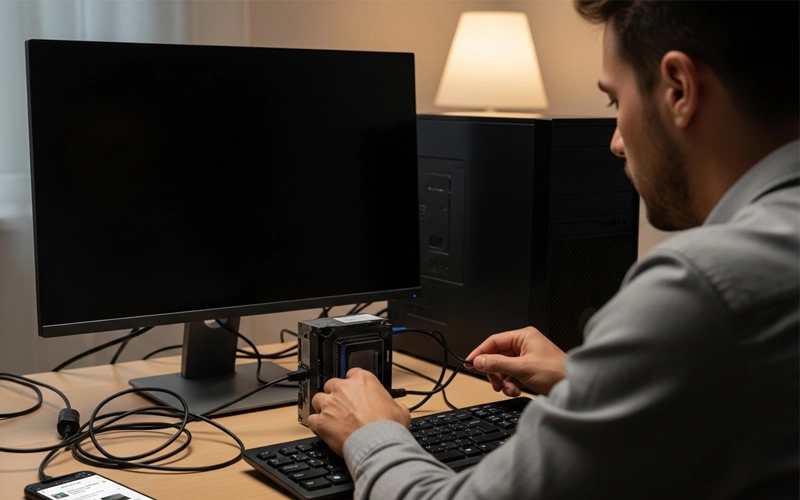
There are few things more frustrating than pressing the power button and getting nothing in return. No lights, no sound, no fan, no display — just complete silence. In that moment, it is normal to panic and think the computer has completely died. But that is not always true. In many cases, the issue is much simpler and easier to fix than it first seems.
If my computer won’t turn on, the cause is often something very basic. Sometimes it’s nothing more than a slightly loose cable or a plug that hasn’t been fully connected. Other times the charger is faulty, or the battery has fully drained without any warning. It can even be something as small as a switched-off extension board that goes unnoticed. In a few cases, the issue may be with the power button or the power supply unit. And sometimes the computer is actually running, but the screen is not displaying anything, which makes it look completely dead. There are also situations where it turns on but gets stuck early due to a minor software issue.
This guide uses simple English so it does not feel confusing or heavy. If you are trying to figure out what to do if my computer won’t turn on, start with the basic checks first. And if you are wondering what do I do if my computer won’t turn on, the best approach is to stay calm, check the obvious things first, and only dig deeper if needed.
First, Do Not Panic
When a computer refuses to start, most people just keep pressing the power button again and again, hoping it will suddenly come back to life. But honestly, that rarely helps. In fact, it usually just makes things more frustrating because you’re not really checking what’s actually wrong. A better first step is to stop for a moment and take a proper look at the machine.
Try asking yourself a few simple things. Was it working fine earlier in the day? Did it stop after a power cut? Was it recently moved somewhere else? Did it fall or get knocked? And before it stopped, did you notice anything unusual like a smell, noise, or flickering? These small details can actually tell you a lot. A computer doesn’t just stop without a reason — something almost always changes before the issue starts.
If you stay calm, you’ll often find the problem quicker than you expect. A lot of computers that seem completely “dead” usually aren’t dead at all. Most of the time, they’re just not getting proper power or they’re stuck because of a very small fault.
Start With Power, Because Power Is the Most Common Problem
The first thing you should always look at is whether the computer is actually getting power. It may sound very basic, but a lot of startup issues begin right here. Something as small as a loose plug, a switched-off extension board, a faulty adapter, or even a dead wall socket can make the whole system look like it is not responding at all.
If you are using a desktop, go through the power cable properly. Check both ends and make sure it is firmly connected — not just at the system unit but also at the wall socket or power strip. Don’t forget the extension board switch as well, because it can accidentally get turned off without anyone realizing it. If you are using a UPS, see if it is actually powered on and working the way it should. It is also worth trying a different wall socket, since in many cases the problem is not with the computer itself but with the power source.
For laptops, plug in the charger and check if any charging light appears. If nothing shows up, the charger might be faulty, the charging port could be damaged, or the battery might be completely drained. Sometimes, the laptop just needs a bit of time before it responds. Leave it plugged in for 15 to 30 minutes and then try again. When a battery is fully empty, it often does not react immediately, even if everything is fine.
Check Whether the Screen Is the Real Problem
Sometimes the computer is actually on, but the screen stays completely blank. This is quite common in desktop setups. People usually assume the whole system has crashed, but in many cases the monitor is the real issue. It might be turned off, not properly plugged in, or simply set to the wrong input source. So a blank screen doesn’t always mean the computer has stopped working.
If you’re using a desktop, start by checking the basics. Make sure the monitor is powered on, the cable is properly connected, and the correct input source is selected on the screen. If the input is wrong, the display can stay black even when the computer is running fine. If possible, try using a different cable as well. Also take a look at the system unit—if the lights are on or you can hear the fans spinning, then the computer is likely working and the issue is probably with the display.
On a laptop, pay attention to small signs. Check if the power light turns on, listen for fan noise, and see if the keyboard lights respond. If those are active, the system is probably booting normally, but the screen may not be functioning properly. A quick test is to shine a flashlight at the screen from an angle. If you can faintly see an image, it usually means the backlight has failed.
This is why people often get confused when they ask what to do if my computer won’t turn on. In many situations, the computer itself is fine—the real problem is just the display.
Try a Hard Reset or Power Drain
A power reset is a very simple trick, but it can be surprisingly effective. It basically clears out any leftover electrical charge in the system and can fix small temporary startup issues. People often don’t expect it to do much, yet in many cases it actually helps.
On a desktop, first turn the power off if you can, then unplug the main cable. After that, press and hold the power button for around 15–20 seconds. Once done, plug everything back in and try switching it on again. This helps discharge any remaining power inside the system.
For a laptop, start by removing the charger. If the battery can be removed, go ahead and detach it too. Then press and hold the power button for about 15–20 seconds. Once that’s done, plug the charger back in and see if the device powers up. If the battery is built-in, just unplug the charger and still hold the power button for the same time.
It’s a safe and easy method, and it works more often than people think. In fact, it’s usually one of the first things you can try when you’re stuck wondering, “what do I do if my computer won’t turn on.” It may sound too basic, but it fixes a lot of common cases.
Remove Extra Devices and Try Again
Sometimes external devices can stop a computer from starting properly. A faulty USB drive, memory card, external hard disk, or even a printer cable can interfere with the boot process. In a few cases, the system tries to read one of these devices first and then just hangs or gets stuck there.
The simplest way to check this is to unplug everything except the basic essentials. Remove USB drives, external storage, memory cards, printer cables, and any other extra devices you don’t really need. Just keep the power cable, monitor cable, and if required, the keyboard and mouse. Then try turning the computer on again.
If it starts normally, then chances are one of the removed devices was causing the issue. You can plug them back in one at a time later to find out which one is faulty. It’s a very simple step, but honestly it solves the problem more often than people expect when the system freezes during startup or starts acting weird.
Pay Attention to Sounds, Lights, and Behavior
Your computer usually gives small clues about what is going wrong, you just need to notice them. For example, sometimes the fan starts spinning for a moment and then everything suddenly goes silent. In many cases, that can point to a power delivery issue or some other hardware problem. If you hear clicking sounds or repeated spinning noises, it may mean the storage drive or even a fan is starting to fail. And when there are no lights at all, it usually suggests the system is not getting proper power.
In some desktop systems, beep sounds can also appear when something is wrong inside. These beeps are not random at all. They are warning signs that often point to components such as the RAM, graphics card, or the motherboard itself. Different companies use different beep patterns, but the meaning is the same: the computer is trying to tell you something is wrong.
Another common situation is when the computer turns on and then shuts down again. This can happen because of overheating, a faulty power supply, or another internal issue. If the fans are running but the screen stays black, the issue is often linked to RAM, the display, or the motherboard. Sometimes, simply unplugging external devices and trying again can help. If the system starts working after removing them, one of those devices is likely causing the issue, and you can plug them back in one by one later to find the exact fault.
For Laptops, Check the Charger and Battery Carefully
Laptops rely on both the battery and the charger, so there are a few more things that can go wrong compared to a desktop. If the charger is damaged, the laptop might not be getting enough power. If the battery is dead, the laptop may only run while it’s plugged in. And if the charging port is loose, power may not be reaching the system properly.
Take a closer look at the charger. Is the cable damaged anywhere? Is the connector tip bent or loose? Check if any light turns on when it’s plugged into the laptop. If you can, try using another compatible charger to see if the issue changes. Sometimes a charger looks completely fine but still fails to deliver proper power.
If the laptop only works when it’s plugged in, the battery is likely the problem. If it doesn’t respond at all even when connected to power, then the charger or charging port could be at fault. In some cases, the issue can even be inside the laptop’s internal power circuit.
When someone thinks my computer won’t turn on and it’s a laptop, the charger should always be one of the first things to check. Many laptops that seem completely dead are actually just dealing with simple charging issues.
Think About Recent Events
A computer problem usually doesn’t just appear out of nowhere. Most of the time, it starts after something has recently happened, even if it feels unrelated at first. It could be a power outage, a sudden voltage surge during a storm, or maybe the laptop was dropped by mistake. Sometimes it’s something very small, like a drink spilling nearby or a cable getting slightly loose when the device was moved. Even a recent software update can end up causing startup issues.
These little details actually matter a lot because they help you figure out what might have gone wrong. For example, if the computer was working fine yesterday and stopped right after a storm, then a power issue becomes more likely. If it stopped after being carried or bumped, something inside may have come loose. And if it turns on but doesn’t load properly after an update, then the problem is probably related to the system itself.
Thinking in this kind of timeline is one of the most helpful ways to diagnose a computer that won’t turn on. In many cases, the real issue is hidden in something small that happened just before things went wrong.
Not All Startup Problems Are the Same
A computer that does not turn on at all is very different from one that turns on but does not start properly. That difference matters a lot when trying to understand what is wrong.
If there are no lights, no fan noise, and no response at all, the issue is usually connected to power, battery, charger, or some internal hardware fault. On the other hand, if the computer lights up, shows the brand logo, or starts loading and then stops, the problem is more likely related to software or storage. It could be corrupted files, a failing hard drive, or even a damaged operating system.
That is why when people search “what do I do if my computer won’t turn on,” they get many different answers. The truth is that “won’t turn on” does not always mean the same thing. The real fix depends on what the computer is actually doing and what it is not doing.
Check the Memory If You Know Basic Hardware Safety
Loose memory sometimes stops a computer from starting properly. Yeh problem zyada tar desktops mein hoti hai, lekin kuch laptops mein bhi ho sakti hai. Agar RAM theek se apni jagah par fit na ho, to system on ho jata hai lekin boot complete nahi karta.
Agar aapko safe tareeke se case open karna aata hai aur aap comfortable hain, to RAM sticks ko gently nikaal kar dobara sahi tarah laga sakte hain. Lekin is se pehle computer bilkul unplug hona chahiye. RAM ko kabhi force nahi karna chahiye, yeh naturally slide karke apni jagah par fit hoti hai.
Agar problem RAM ki wajah se ho, to usay properly reseat karna issue solve kar sakta hai. Lekin agar aap sure nahi hain, to machine kholna avoid karein aur kisi expert ki help lein. Andar choti si ghalti baad mein bara masla ban sakti hai.
Overheating Can Stop a Computer From Starting
A computer that gets too hot can shut itself down and sometimes it won’t start again until it has properly cooled down. This usually happens because of dust building up inside, air vents getting blocked, or a fan that isn’t working the way it should. It’s more common in older systems or in devices that run for long hours without being cleaned.
If the computer feels unusually warm, it’s better to leave it for some time before trying to turn it on again. Also check if anything is blocking the air vents, like dust, cloth, or even placing the device too close to a wall. In desktop PCs, you can open the case and see if the fans are spinning normally. In laptops, you can usually hear the fan noise if it’s working. If there’s no sound at all, that can be a warning that something is wrong. A fan not working properly can easily force the system to shut down as a safety step.
Sometimes the issue is a bit deeper, like old thermal paste drying out or the cooling system not performing well anymore. Problems like that usually need proper repair, but if you catch them early, you can avoid bigger damage later.
The Power Supply Can Fail Without Warning
Desktop computers rely on a power supply unit, and if that part fails, the computer may not turn on at all. This is one of the more serious hardware problems. A bad power supply can seem completely dead or behave in an unstable way.
If you have already checked the outlet, cable, monitor, and basic connections, the power supply becomes a stronger suspect. Sometimes the fans spin for a second and then suddenly stop. In other cases, nothing happens at all when you press the power button. There are also situations where the computer turns on briefly, shuts down randomly, and then refuses to start properly again.
Power supply problems are not always easy to notice, and they are not always safe to test without proper tools. If you suspect this issue, a technician can test it properly.
Motherboard Problems Are More Serious
The motherboard is the main board that connects all the parts of the computer. If it is damaged, the computer may refuse to start no matter what you try. Liquid spills, power surges, overheating, or physical damage can all affect it.
Motherboard issues often look like other problems, which makes them difficult to diagnose at home. There may be no lights, no beeps, and no fan response. In some cases, the system may briefly start and then die. If the motherboard is faulty, repair may be expensive or sometimes not worth it, depending on the age of the computer.
That is why it is so important to rule out simpler causes first. Many people assume the worst too early, but sometimes the fix is much easier than replacing the motherboard.
When Software Is the Problem
Sometimes the computer does turn on, but Windows or another operating system does not load correctly. You may see a spinning circle, a frozen logo, or an error message. In these cases, the hardware may be fine, but the operating system is damaged or confused.
This can happen after updates, sudden shutdowns, malware, or storage failure. Startup repair tools may help. In some situations, the computer needs to be booted in recovery mode. In more serious cases, the operating system may need to be repaired or reinstalled.
This is very different from a machine that shows no signs of life at all. That is why it helps to look carefully. Not every black screen means the same thing.
Protect Your Important Files
If the computer still shows signs of life, even for a short time, try to save your important files as soon as possible. Data should always be protected before the machine gets worse. Copy documents, photos, videos, and work files to a safe place if you can still access them.
If the computer is making strange clicking sounds or shutting down suddenly, avoid forcing it on again and again. That can make the problem worse, especially if the storage drive is failing. In some cases, the computer itself may be repairable, but the files may matter more than the device.
A good habit is to back up data regularly so that a power problem does not turn into a data disaster.
When You Should Stop Troubleshooting at Home
There are times when it’s simply better to stop and call a professional instead of trying more things on your own. If you notice a burning smell, see smoke, find any liquid damage, hear unusual clicking from inside the machine, or you just feel unsure about opening the case, it’s best to stop right away. Safety is always more important than guessing.
You should also step back if you’ve already checked the basic things and the computer still shows no sign of power. In that situation, the issue is likely internal and needs proper testing. A repair technician can check the charger, battery, power supply, RAM, motherboard, and storage much more accurately than trial-and-error fixes.
Sometimes, knowing when to stop is just as important as knowing what to check. It can actually save you from bigger damage and unnecessary expenses.
FAQs:
- Why is my computer not turning on even after pressing the power button?
If my computer won’t turn on, it is usually due to a power-related issue. This can include a loose power cable, a faulty charger, a dead battery, or a problem with the power outlet. In some cases, internal hardware like the power supply or motherboard may also be responsible.
- What should I check first if my computer won’t turn on?
The first thing to check is power. Make sure the plug is properly connected, the switch is on, and the outlet is working. For laptops, check if the charger light is on. Many cases of what to do if my computer won’t turn on start with simple power issues that are easy to fix.
- What do I do if my computer won’t turn on at all?
If you are thinking what do i do if my computer won’t turn on, start with a power reset. Unplug everything, hold the power button for 15–20 seconds, then try again. If that does not work, check charger, battery, and display connections step by step.
- Can a dead battery stop a laptop from turning on?
Yes, a completely drained or damaged battery can stop a laptop from starting. Some laptops will not respond until the charger is connected for a few minutes. If the battery is faulty, the laptop may only work while plugged in.
- What if my computer turns on but the screen stays black?
In that case, the computer may be working but the display is not showing anything. The issue could be a loose monitor cable, wrong display input, or a faulty screen. Sometimes the system is running but the screen is the problem, not the computer itself.
- Can a faulty charger stop my laptop from turning on?
Yes, a damaged charger or broken charging cable can prevent the laptop from receiving power. Even if the charger looks fine, it may not be delivering electricity properly. Trying a different charger can help confirm this issue.
- Is it possible that my computer is on but not showing anything?
Yes, this happens often. The system may be running, but the screen is off or not connected properly. You may notice fan noise, lights, or keyboard activity even when the display is blank.
- Can overheating cause a computer not to turn on?
Yes, overheating can stop a computer from starting as a safety measure. Dust, blocked air vents, or a broken fan can cause this. Letting the system cool down and cleaning vents may help in some cases.
- What does it mean if there are no lights or sounds at all?
If there is complete silence, no lights, and no fan movement, it usually indicates a power failure. This could be a bad power supply, dead charger, faulty battery, or motherboard issue.
- Should I open my computer if it won’t turn on?
Only open it if you have basic knowledge of hardware safety. Incorrect handling can cause more damage. For most users, it is better to try external checks first before opening the system.
Final Thoughts
A computer that will not turn on can be very frustrating, but it is not always a serious problem. Most of the time, the issue is small and can be fixed easily, like a loose cable, a dead charger, a drained battery, a switched-off power strip, a loose screen connection, or just needing a simple power reset. If my computer won’t turn on, the best thing to do is stay calm and start with the basics by checking power, screen, cables, accessories, sounds, and any recent changes one by one. The key is not to rush, because careful checking usually works better than panic. With a patient step-by-step approach, many problems can be solved in minutes, while others may need repair, but either way it helps you fix the issue, protect your files, and reduce stress.





Add comment