
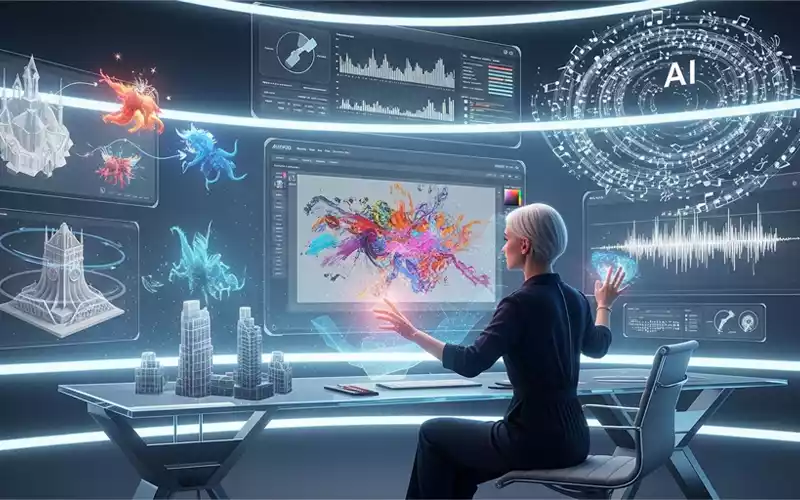
Over the past few decades, artificial intelligence has grown in ways few could have imagined. What started as simple programs that could crunch numbers or follow basic instructions has evolved into sophisticated systems capable of learning, reasoning, and even creating on their own. One of the most fascinating developments in this journey is Generative AI—a branch of AI that can generate entirely new content by recognizing patterns from existing data. This technology isn’t just changing industries; it’s transforming how we think about creativity and how humans interact with machines, opening doors to possibilities we’re only beginning to explore.
Generative AI is a bit different from the AI we’re used to. Traditional AI is really good at things like predicting outcomes, sorting data, or finding the best solution to a problem. Generative AI, however, takes it a step further—it can actually create new content from scratch. Whether it’s writing text, making images, composing music, or even generating videos, it has a way of mimicking human creativity. This has led to some exciting possibilities in areas like entertainment, healthcare, education, business, and scientific research, giving people new tools to experiment and innovate.
At its core, generative AI is all about teaching computers to create content on their own. One popular method uses something called Generative Adversarial Networks, or GANs. These involve two neural networks: one generates new content, while the other checks how realistic it is. Over time, the generator learns to make outputs that are almost indistinguishable from real data. Another powerful approach involves transformer models, which are behind many advanced language systems. Transformers use attention mechanisms to understand context and the flow of information, allowing AI to produce text that feels coherent, relevant, and human-like.
How Generative AI Is Changing Creativity
One of the most exciting things about new creative tools is how they can spark our imagination in ways we never expected. Writers, for example, can jot down rough story ideas, play with dialogue, or explore fresh concepts when they feel stuck. Musicians often find themselves experimenting with new melodies, combining their own intuition with the possibilities these tools offer to create sounds that feel both surprising and personal. Even designers and visual artists are discovering ways to push boundaries, trying out ideas quickly and seeing results instantly. These tools don’t replace the artist—they just give creativity a little nudge, helping people bring their visions to life more easily and with more freedom.
Visual arts have been given a whole new playground thanks to AI. Today, artists can experiment with digital paintings, 3D models, and animations in ways that used to take weeks or months to perfect. It’s like having a creative partner who can instantly bring bold ideas to life. Even in fashion, designers are turning to AI to dream up fresh patterns and clothing styles, making the design process faster, more playful, and full of possibilities they might never have imagined before.
The entertainment and media industries are quickly embracing new tools to enhance creativity. Filmmakers and game developers now have the ability to bring realistic characters, detailed landscapes, and imaginative scenarios to life, which helps save both time and money without compromising on quality. These technologies also allow creators to explore different storylines and experiment with fresh ideas, making it possible to deliver content that keeps audiences excited and engaged.
Generative AI in Business and Marketing
Beyond the creative sector, generative AI is changing the way businesses approach marketing. Many brands now use it to create everything from product descriptions and ads to social media posts. These tools help maintain a consistent tone while tailoring messages for different audiences, making it easier for companies to reach more people without losing their unique voice.
Generative AI is transforming how products are designed. Companies can now test new product ideas virtually, see how the market might respond, and tweak their designs before making anything in the real world. This approach saves both time and money, and it helps businesses launch innovative products faster. AI simulations can also give insights into what customers might prefer, suggest better packaging, and even create experiences tailored to individual users.
Customer service is evolving at lightning speed, and companies are discovering fresh ways to engage with their customers. Virtual assistants today do more than just answer questions—they understand context, provide accurate responses, and even suggest solutions before small issues escalate. This creates a more personal experience, making customers feel appreciated while helping businesses build stronger, lasting relationships.
Transforming Healthcare Through AI
Healthcare is one of the most critical areas where generative AI is having a big impact. Researchers are using AI to simulate molecular structures, design new drugs, and even predict how treatments will work. By looking at large amounts of data, AI can suggest new compounds that might work better than current options, speeding up the drug discovery process a lot.
Generative AI is also being used in medical imaging, helping professionals improve or reconstruct images for more precise diagnoses. It can even create synthetic medical data, which is highly valuable for research and training, all while protecting patient privacy. This feature is especially crucial in areas like clinical trials, where access to large datasets is often limited due to confidentiality.
Education is also being transformed by generative AI. It can produce learning materials tailored to each student’s unique style and pace. From practice exercises to explanatory content and adaptive assessments, AI helps teachers offer more personalized learning experiences. This makes high-quality educational resources accessible to students everywhere, breaking down barriers of location or cost.
How Generative AI Works
Understanding how generative AI works helps us appreciate what it can do. These systems learn from large datasets, identifying patterns and structures within the data. For example, when generating text, AI models study sentence structure, word choices, and context to produce meaningful passages. Similarly, in generating images, AI learns about shapes, colors, textures, and styles to create unique visuals.
Generative Adversarial Networks (GANs) are widely used for visual content. The generator creates images, while the discriminator checks them against real examples. This back-and-forth continues until the generator produces content that looks just like real images. GANs work especially well for creating realistic human faces, landscapes, and even various art styles.
Transformer models, like the ones behind advanced language tools, work in a unique way. They look at sequences of information and use attention mechanisms to figure out which parts are important. This helps them keep context, generate sensible sequences, and even pick up on subtle things like humor or emotion. Thanks to this, transformers can create text, code, or even multimedia that feels like a real person made it.
Real-World Applications of Generative AI
Generative AI has moved from theory into real-world applications. In literature and journalism, it supports writers by suggesting ideas, helping draft articles, or summarizing complex topics. Musicians can experiment with AI-assisted compositions to explore fresh melodies and rhythms. In the visual arts, AI tools make it easier to create images, add video effects, or even produce full animated sequences
Businesses are increasingly using generative AI to spark design and innovation. It can help prototype products, simulate market conditions, and even anticipate what users might want. Retailers are putting AI to work by offering personalized recommendations, which not only boost sales but also make customers happier. In finance, AI plays a role in generating reports, assessing risks, and predicting market trends with impressive accuracy.
Businesses are increasingly using generative AI to spark design and innovation. It can help prototype products, simulate market conditions, and even anticipate what users might want. Retailers are putting AI to work by offering personalized recommendations, which not only boost sales but also make customers happier. In finance, AI plays a role in generating reports, assessing risks, and predicting market trends with impressive accuracy.
Challenges and Ethical Considerations
Despite its potential, generative AI comes with several challenges. A key concern is its misuse. Content produced by AI can be exploited to spread misleading information, create deepfakes, or generate fraudulent digital material. Such uses could have serious social and legal consequences, highlighting the importance of responsible use and proper regulatory oversight.
Bias in AI-generated content is a real concern. Since AI learns from existing data, any biases in those datasets can show up in what it produces. This might lead to unfair or culturally insensitive content, so it’s important to carefully select training data and keep evaluating the results. Another challenge is transparency—generative AI models are complex and often work like “black boxes,” making it hard to see exactly how they come up with certain outputs.
Accountability matters a lot, especially in areas like healthcare, finance, and legal documentation. People need to feel confident that the outputs they receive are reliable and safe. To use generative AI responsibly, it’s important to have ethical guidelines, diverse datasets, and human oversight in place.
The Future of Generative AI
Generative AI is still evolving, and its future looks incredibly promising. As models get smarter, they’ll be able to create content that’s almost impossible to tell apart from what humans make. When combined with augmented reality (AR) and virtual reality (VR), AI could even build fully immersive experiences, generating worlds, characters, and stories on the fly.
Multi-modal AI is opening up new frontiers. Systems that can understand and generate content across text, images, audio, and video at the same time will create more possibilities in education, entertainment, and communication. We’ll also see human-AI collaboration grow, with AI acting more like a creative partner than a replacement, boosting productivity and innovation across different fields.
Conclusion
Generative AI is one of the most exciting technological breakthroughs of our time. It can create new content, simulate complex systems, and support human creativity in ways we couldn’t imagine before. Of course, there are challenges like ethical concerns, bias, and possible misuse, but the advantages are clear. When used responsibly, generative AI opens up new creative possibilities, speeds up innovation, and even changes the way we interact with technology.
From art studios to hospitals, classrooms, and offices, generative AI is becoming part of how we work and create. It’s not just a tool—it’s a helper that opens doors to ideas we might not have imagined before. As AI grows, it will change the way we think, make, and solve problems, showing that humans and machines can work together rather than compete.
Generative AI is not merely about creating content; it is about amplifying human potential. By blending analytical capabilities with creative intuition, it opens up possibilities we might not have imagined before. Whether in writing, art, music, science, or business, generative AI is gradually changing the way we work, learn, and live, making the world feel more connected, innovative, and truly extraordinary.
FAQ on Generative AI
- What is generative AI?
Generative AI is a type of artificial intelligence that can create new content, like text, images, music, or videos, by learning patterns from existing data. Unlike traditional AI, which focuses on predictions or classification, generative AI produces original and creative outputs. - How does generative AI work?
Generative AI uses advanced machine learning models, such as Generative Adversarial Networks (GANs) or transformers. These systems learn patterns from large datasets and generate new content that mimics real-world data while being unique. - Where is generative AI used?
Generative AI is used in many fields, including content creation, entertainment, marketing, healthcare, education, product design, and scientific research. It helps create text, images, music, simulations, and even medical research data. - Can generative AI replace human creativity?
No, generative AI enhances human creativity rather than replacing it. It acts as a tool or partner, helping humans generate ideas faster, explore new styles, and improve productivity in creative tasks. - What are the benefits of generative AI?
Generative AI saves time and cost, supports innovation, enables personalized content, enhances creativity, and can assist in complex tasks like drug discovery or virtual simulations. - Are there risks associated with generative AI?
Yes, generative AI can be misused to create misleading content, deepfakes, or biased outputs if not monitored. Ethical use, proper regulation, and human oversight are essential. - Is generative AI difficult to learn or use?
While the underlying technology is complex, many AI tools and platforms are user-friendly. Businesses, creators, and educators can use AI-generated content without needing to understand all technical details. - What is the future of generative AI?
The future of generative AI includes more advanced content creation, multi-modal AI (handling text, image, and audio together), immersive virtual experiences, and closer collaboration between humans and AI in creative and analytical work.





Add comment