
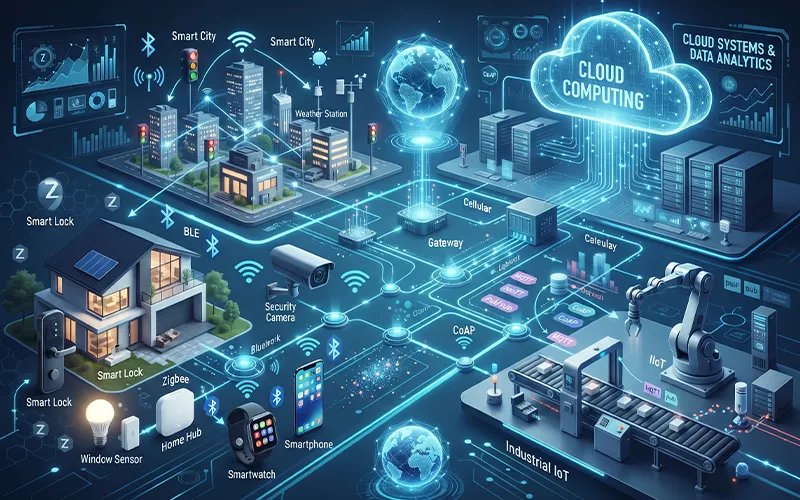
Introduction
Smart devices are becoming an important part of modern life. People use smart watches, fitness trackers, smart televisions, security cameras, connected appliances, smart speakers, and many other devices every day. Businesses also depend on connected machines to monitor operations, collect information, and automate different tasks. Although these devices may look very different, they all need one important thing: a reliable way to communicate.
This is where internet of things (iot) protocols become important. They provide communication rules that help connected devices exchange information with applications, gateways, servers, cloud platforms, and other devices. Without suitable communication methods, a smart sensor may collect useful information but have no effective way to deliver that information to another system.
The Internet of Things is not limited to smart homes. It is used in factories, hospitals, farms, transportation systems, warehouses, retail businesses, energy management, and many other areas. As more physical objects become connected, understanding how they communicate becomes increasingly useful for students, developers, business owners, and technology professionals.
In this guide, we will explain internet of things (iot) protocols in simple English. You will learn how they work, why different protocols exist, what common technologies are used, how security affects connected devices, and how IoT is being used in manufacturing and industrial environments.
What Is the Internet of Things?
To understand communication protocols, it is first important to understand what is internet of things technology. The Internet of Things, usually called IoT, refers to physical objects that can collect, process, and exchange information through a network.
An IoT device can contain sensors, software, processors, communication hardware, or a combination of these components. A temperature sensor, for example, can measure the temperature of a room and send the reading to another device or software platform. A smart door sensor can detect whether a door is open or closed and send an alert to a mobile application.
IoT can also involve much larger systems. A factory may connect hundreds of machines to a central monitoring platform. A farm may use sensors to measure soil moisture and weather conditions. A logistics company can use connected tracking equipment to monitor vehicles or shipments.
The main idea is simple: physical objects collect information, communicate that information, and sometimes receive instructions to perform an action. In these systems, internet of things (iot) protocols provide the communication rules needed to move information between different components.
How IoT Communication Works
The basic communication process is easier to understand when it is divided into simple steps. First, a device collects information through one or more sensors. The device then processes the information and prepares it for transmission.
The communication system sends the information through a network. Depending on the design, the data may travel directly to another device, through a local gateway, or to a cloud platform. The receiving system then processes the information and may store it, display it, analyze it, or use it to trigger an action.
For example, consider a smart farming system. Soil sensors can monitor and detect moisture levels across various areas of a field. The readings are sent to a central platform. If the software detects that the soil is too dry, it can notify the farmer or activate an automated irrigation system.
This process shows why internet of things (iot) protocols help connect physical devices with software systems. The protocol provides the rules that determine how information is exchanged between different parts of the system.
Common Types of IoT Communication Technologies
There are many communication technologies available for connected devices. Some are designed mainly for short-distance communication, while others can cover much larger areas. Some focus on low energy consumption, while others provide higher data speeds.
The choice depends on the project. Developers may consider range, bandwidth, power usage, reliability, cost, security, device capabilities, and network conditions before selecting a communication technology.
A smart home may use several technologies at the same time. For example, a wearable device may communicate with a smartphone through Bluetooth, while the smartphone uses Wi-Fi to send information to a cloud service.
When developers compare internet of things (iot) protocols, they normally look at the complete communication environment instead of considering only one technical feature.
MQTT
MQTT stands for Message Queuing Telemetry Transport. It is a lightweight messaging protocol that is widely associated with IoT applications. It is useful when devices have limited resources or when network bandwidth needs to be used efficiently.
MQTT commonly uses a publish-and-subscribe model. A device publishes information to a topic, and other systems subscribe to that topic. A broker manages the messages between publishers and subscribers.
For example, a temperature sensor could publish readings to a topic related to room temperature. A monitoring application subscribed to that topic can receive the readings without creating a direct connection to the sensor.
Because of its lightweight design, MQTT is often considered when designing systems that contain many connected devices. It is one of the communication choices developers may evaluate when building systems based on internet of things (iot) protocols.
CoAP
CoAP means Constrained Application Protocol. It was designed for small devices and networks where resources such as memory, processing power, and bandwidth may be limited.
CoAP follows concepts that are familiar from web communication but is designed with constrained environments in mind. It can be useful for sensors and other small devices that need to communicate without using unnecessary resources.
The choice between CoAP and other technologies depends on the architecture of the IoT system and the requirements of the application. Understanding these differences helps developers select suitable internet of things (iot) protocols for specific devices and networks.
HTTP and HTTPS
HTTP is the communication method behind much of the traditional web. IoT devices can use HTTP to communicate with web servers, APIs, and cloud applications.
HTTPS adds encryption to HTTP communication. This helps protect information while it travels between a device and a server. Secure communication becomes especially important when a system handles private information or controls important equipment.
HTTP is widely supported and easy for developers to understand. However, it may not always be the most efficient option for very small devices with limited battery power or processing resources.
Bluetooth Low Energy
Bluetooth Low Energy, commonly called BLE, is designed for short-range communication with relatively low power consumption. It is widely used in wearable devices and small connected products.
Fitness trackers, smart watches, sensors, and some medical devices can use BLE to communicate with nearby smartphones or other equipment. A device can collect information and transfer it to a phone, where an application can display or process the data.
BLE is particularly useful when a device needs to operate for a long time on a small battery. It can therefore be considered when the main requirement is short-range and energy-efficient communication.
Zigbee
Zigbee is a wireless technology commonly used for low-power connected devices. It can be useful in smart homes, automation systems, and sensor networks.
One notable feature is its support for mesh networking. In a mesh network, devices can communicate through other devices, helping information travel across an area without requiring every device to have a direct connection to the central system.
Smart lights, switches, sensors, and automation equipment can use this type of communication architecture.
Wi-Fi
Wi-Fi is one of the most familiar wireless networking technologies. It provides relatively high data speeds and is already available in many homes, offices, shops, and industrial environments.
Smart televisions, security cameras, appliances, and other connected products can use Wi-Fi to communicate with local networks and internet services.
The main limitation for some IoT devices is power consumption. A device that constantly uses Wi-Fi may consume more energy than a small sensor designed to operate for months or years on a battery.
Internet of Things Examples in Everyday Life
There are many internet of things examples that people can see in daily life. Smart lights can be controlled through mobile applications or automated schedules. Smart thermostats can monitor environmental conditions and adjust settings. Smart doorbells can detect movement and send notifications.
Wearable devices are another common example. A fitness tracker can collect information about activity and send it to a smartphone. A smart watch can communicate with applications and display notifications, messages, or other information.
Connected appliances can also become part of an IoT environment. A smart washing machine may provide information about its current cycle, while a connected refrigerator can monitor certain internal conditions.
Vehicles are becoming increasingly connected as well. Modern connected vehicles can collect information about location, performance, maintenance, and other operating conditions.
These applications demonstrate how internet of things (iot) protocols can support communication between physical devices, mobile applications, gateways, and online platforms.
Industrial Internet of Things
The industrial internet of things is commonly known as IIoT. It focuses on connected equipment, machines, sensors, software, and systems used in industrial environments.
Factories can install sensors on machines to collect information about temperature, pressure, vibration, speed, energy consumption, and operating conditions. Software can then analyze this information and provide useful reports or alerts.
One important use of IIoT is equipment monitoring. Instead of relying entirely on manual checks, a company can continuously monitor machine conditions through connected sensors. If unusual readings appear, maintenance staff can investigate the equipment.
Some industrial internet of things examples include connected production machines, warehouse tracking systems, automated inspection equipment, industrial sensors, energy monitoring systems, and machine condition monitoring platforms.
IIoT can also connect different parts of a production environment. Information from machines, inventory systems, quality-control equipment, and management platforms can be combined to provide a clearer view of operations.
For industrial environments, internet of things (iot) protocols need to be selected according to requirements such as reliability, network conditions, data volume, security, and the type of equipment being connected.
What Risk Is Posed by Internet of Things Devices?
A common question is what risk is posed by internet of things devices? The answer depends on the type of device, how it is configured, what information it collects, and how it connects to other systems.
Security weaknesses can create opportunities for unauthorized access. Weak passwords, outdated software, insecure network services, poor authentication, and improper configurations can increase exposure.
An insecure IoT device can also become a possible entry point into a larger network. If a connected device is compromised, attackers may attempt to use it to reach other systems depending on the network architecture and available permissions.
Privacy is another consideration. Some connected products can collect information about locations, activities, usage patterns, or environmental conditions. Organizations should understand what information is collected, why it is needed, and how it will be protected.
These risks do not mean that connected devices should be avoided. Instead, they show why security needs to be considered during device design, deployment, and ongoing maintenance.
What Is Internet of Things Security?
A simple explanation of what is internet of things security is the protection of connected devices, networks, software, and data from unauthorized access and other security threats.
Security can involve multiple layers. Devices should have secure authentication and appropriate access controls. Communication should use suitable protection when sensitive information is being transferred. Software and firmware should be updated when security fixes become available.
Organizations should also monitor connected systems. Unusual activity, unexpected network communication, or repeated failed login attempts may indicate that a device or account needs investigation.
Another important concept is least privilege. A device should not automatically receive access to every part of a network. Giving systems only the permissions they require can reduce the potential impact of a security problem.
Security should therefore be part of the complete IoT lifecycle, from initial design to deployment, updates, monitoring, and eventual replacement. Secure internet of things (iot) protocols can contribute to protecting information as it moves between connected components.
Internet of Things Software Development
Internet of things software development involves creating software that communicates with connected devices and processes the information they generate.
Developers may work on embedded software, mobile applications, web dashboards, APIs, cloud platforms, databases, automation systems, and data-processing services. Each part needs to communicate correctly with the others.
IoT software development can present challenges that are less common in traditional applications. Devices may lose their network connection, have limited memory, run on batteries, or send information at different times.
Developers therefore need to consider error handling and unreliable network conditions. The system should be able to recover from temporary communication failures instead of stopping completely.
Testing is also important. Developers should test normal operation as well as network interruptions, invalid data, device failures, high traffic, and security-related situations.
During software planning, developers also need to understand how internet of things (iot) protocols will interact with APIs, databases, devices, gateways, and cloud services.
Frequently Asked Questions
1. What are internet of things (iot) protocols?
They are communication rules and technologies that allow connected devices and software systems to exchange information. Different options are designed for different requirements, such as low power consumption, short-range communication, higher bandwidth, or efficient messaging.
2. Why are these protocols important for IoT?
They provide a structured way for devices, applications, gateways, and servers to communicate. Without suitable communication methods, connected devices would have difficulty exchanging information reliably.
3. What is the difference between IoT and IIoT?
IoT is a broad term covering connected physical devices used in many environments. IIoT focuses more specifically on connected machines, sensors, equipment, and software used in industrial and business operations.
4. Can Wi-Fi be used for IoT devices?
Yes. Wi-Fi can be useful for devices that require relatively high data speeds and have access to sufficient power. However, very small battery-powered devices may benefit from technologies designed for lower energy consumption.
5. Why is IoT security important?
IoT security helps protect devices, networks, applications, and data from unauthorized access and other threats. Poor security can expose connected systems to attacks, privacy problems, or unauthorized control.
6. How is IoT used in manufacturing?
Connected sensors can monitor machines, collect production information, track equipment, support maintenance, monitor energy consumption, and provide operational data to software systems.
7. What skills are needed for IoT software development?
Useful skills include programming, networking, databases, APIs, cloud computing, cybersecurity, embedded systems, and data processing. The required skills depend on the type of IoT project.
8. What are some simple internet of things exampless?
Examples include smart lights, fitness trackers, connected thermostats, smart cameras, wearable devices, connected vehicles, smart appliances, environmental sensors, and automated irrigation systems.
Conclusion
The Internet of Things is changing the way physical objects interact with software, networks, and people. From simple smart home products to complex industrial machines, connected devices need reliable methods for exchanging information.
Understanding internet of things (iot) protocols makes it easier to understand how these systems operate. MQTT, CoAP, HTTP, HTTPS, Bluetooth Low Energy, Zigbee, Wi-Fi, and other technologies can serve different purposes depending on the requirements of a project.
The right choice depends on factors such as power consumption, communication range, bandwidth, reliability, security, cost, and device capabilities. A small battery-powered sensor may need a very different solution from a connected industrial machine or high-resolution security camera.
IoT is also becoming increasingly important in manufacturing, agriculture, transportation, retail, smart buildings, and business operations. With the growth of artificial intelligence, cloud computing, and edge computing, connected systems are becoming more capable and useful.
The most important point is that IoT is not simply about putting physical devices online. A successful system connects hardware, communication, software, data, and security in a way that solves a real problem. When these components are planned carefully, connected technology can provide useful information, support automation, and improve how people and businesses manage the physical world.
If you want to read more interesting and detailed guides, visit EmbossitWorld now. You’ll find useful Information, and a lot of practical information. Don’t miss out.





Add comment