
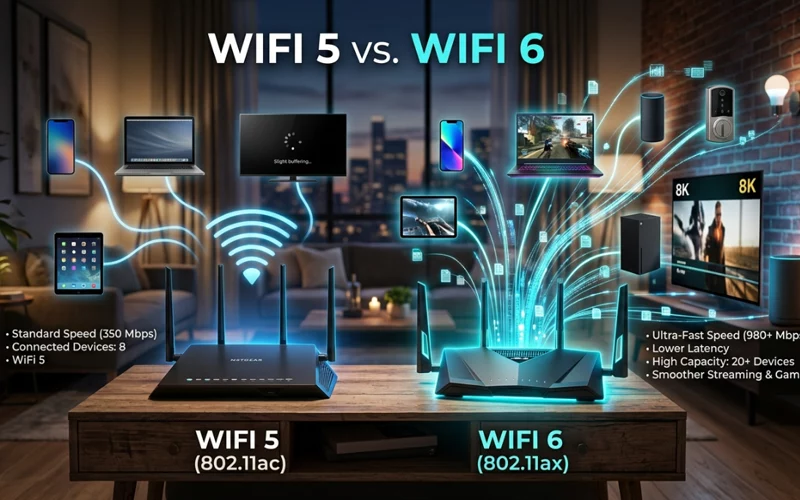
Choosing a router looks easy until you actually start comparing the numbers, speed claims, and technical terms on the box. Many people buy a new router only because they hear that newer WiFi is “faster,” but the real answer is more practical than that. The best choice depends on how many devices you use, how much video streaming you do, whether you work from home, and how much your home is covered with walls or floors. This guide explains everything in a simple way so you can understand wifi 5 vs wifi 6 without getting lost in technical language.
WiFi 5 vs WiFi 6 Meaning
WiFi 5 is the common name for the 802.11ac standard, while WiFi 6 is the newer 802.11ax standard. Both are wireless technologies, but WiFi 6 was designed to handle modern internet use better. That does not mean WiFi 5 became useless. It continues to perform reliably in many homes and workplaces, particularly where internet speeds are modest and only a few devices are connected at the same time.
The biggest difference is not only speed. It is also about how efficiently the router manages traffic. WiFi 5 was built for a time when homes had fewer smart devices. WiFi 6 is designed for modern homes where multiple devices like smartphones, laptops, smart TVs, security cameras, wearables, and speakers stay connected to the internet all at once. That is why people often search for wifi 5 vs wifi 6 differences before buying a new router.
A simple way to think about it is this: WiFi 5 is like a busy road that still works, while WiFi 6 is like a smarter road system that moves traffic more smoothly. Both can take you to the same place, but the newer one handles pressure better.
Speed Is Not the Whole Story
Many users ask about wifi 5 vs wifi 6 speed, and that is a fair question because speed is usually the first thing people notice. WiFi 6 can support higher top speeds than WiFi 5, but real-life speed depends on many things. Your internet plan, your router quality, the distance from the router, and even the device you are using all affect the final result.
In real homes, the speed difference is not always huge in a simple single-device test. If only one phone is downloading a file in the same room as the router, WiFi 5 may still feel very fast. When multiple devices connect to and actively use the network at the same time, WiFi 6 delivers smoother performance because it distributes bandwidth more efficiently across all connected devices.
That’s why a lot of people often feel unsure or get a bit confused about it. They hear that WiFi 6 is much faster, but then their phone does not suddenly become twice as fast. That happens because internet performance is not just about the wireless standard. If your internet connection itself is limited, the router cannot create speed out of nothing. Still, WiFi 6 gives more room for better performance, especially when your home network is busy.
Another important point is latency. WiFi 6 can often respond more smoothly when many devices are connected. That matters for gaming, video calls, and online work. So when you look at wifi 5 vs wifi 6 speed, it makes more sense to judge how the connection performs in everyday use instead of focusing only on the highest speed written on the packaging.
Everyday Performance
The practical difference becomes clearer when you imagine a regular home. In one room, someone is watching Netflix. In another, a child is playing an online game. A laptop is running a software update in the background, two smartphones are browsing social feeds, and a smart speaker sits idle, ready to respond to any voice command. On WiFi 5, all of this can still work, but the router has to work harder. With WiFi 6, the network is designed to handle this type of heavy shared usage more smoothly and efficiently.
This is the point where WiFi 6 starts to feel noticeably more advanced and upto date. It’s not just about boosting the speed of a single device. It focuses on ensuring multiple devices remain smoothly connected without interruptions at the same time. That is why families, shared apartments, home offices, and small businesses often benefit more from the newer standard. If your home is very quiet online and only a few devices are active, WiFi 5 may still be enough. But if your network is always busy, WiFi 6 usually gives a smoother experience.
There is also an important improvement in how the router communicates with devices. WiFi 6 can send data more efficiently, which reduces waiting time. In simple words, it tries to waste less time. That can make the connection feel more responsive, even when the headline speed difference does not look dramatic.
Range, Walls, and Real Signal Quality
People often ask about wifi 5 vs wifi 6 range, and this topic is more useful than many buyers realize. Range is not only about how far the signal can travel. It is also about how well the connection stays strong through walls, furniture, and other obstacles.
In theory, WiFi 6 can perform better in crowded environments and may give a more stable connection across your home. But range is not magically doubled just because the router says WiFi 6. The quality of antennas, the router design, your home layout, and the building materials all matter a lot. A cheap WiFi 6 router can still perform worse than a good WiFi 5 router.
This is why buyers should avoid thinking that the newest standard automatically means the best coverage. If your home has thick walls, a large floor plan, or dead zones, a single router may still struggle. In that case, mesh systems, access points, or better router placement can matter more than the WiFi version itself. Still, when everything else is equal, WiFi 6 often handles range more intelligently because it is better at staying efficient under pressure.
If you live in a small apartment, the difference in range may not feel dramatic. But in a larger house, WiFi 6 can be more helpful because it is better at keeping stable performance when multiple rooms are involved. So the range question is really about stability as much as distance.
Router Choice Matters
When people search for wifi 5 vs wifi 6 router, they often focus too much on the generation number and not enough on the router itself. The truth is that the router model, processor, antenna design, and firmware quality can make a big difference. A good router with WiFi 5 can still be better than a weak WiFi 6 router in some situations.
If you are using a basic internet plan and live in a small space, a decent WiFi 5 router may be all you need. It can save money and still give a stable connection. But if your home has many connected devices, you stream in 4K, play online games, or use cloud services a lot, a WiFi 6 router is usually the smarter long-term choice.
Another thing to think about is device support. For WiFi 6 to show its full value, your phone, laptop, or tablet must also support it. If your devices are older, you will still connect, but you may not enjoy the full benefit. That is why router buying should always match your devices and your usage, not just the marketing on the box.
A lot of people buy routers only because the spec sheet looks impressive. That is a mistake. A better approach is to ask what your home actually needs. If your internet usage is simple, there is no need to overspend. If your setup is busy and growing, then a WiFi 6 router makes more sense because it gives more headroom for the future.
Best Choice for Different Users
For students, single users, and people with a light internet routine, WiFi 5 can still be a very practical choice. It supports normal browsing, video streaming, online classes, and social media without trouble. If the internet plan is moderate and the space is small, there may not be a strong reason to upgrade immediately.
For families, remote workers, gamers, and smart-home users, WiFi 6 usually offers more value. It handles crowded networks better and keeps things more stable when many devices are online. That becomes important when one person is on a video call, another is watching a live stream, and someone else is downloading large files. In such a setup, the network can feel less stressed.
For business use, WiFi 6 is often the better option because offices usually have more users and more traffic. Stability matters as much as speed there. A smooth connection during meetings, shared cloud work, and file transfers can save time and reduce frustration. That is one reason many businesses now prefer newer hardware even if older routers still function.
A good way to decide is to think about the next two to four years, not only today. If you expect more devices in your home, more streaming, or a faster internet plan later, WiFi 6 gives you more space to grow. If your setup is simple and likely to stay simple, WiFi 5 remains a solid and budget-friendly option.
Small Tech Improvements
One reason WiFi 6 feels better in real use is that it was designed to be more efficient in crowded environments. It can manage data flow in a smarter way, which reduces congestion. That means less waiting and less slowdown when many devices are active at once. You may not always notice the technology behind it, but you often feel the result.
Another useful improvement is better support for battery life on connected devices. Some devices can save power more effectively because they do not need to listen to the network constantly. For phones, tablets, and smart home products, that can be helpful over time. This is not usually the first thing buyers think about, but it is one more reason newer WiFi can be more practical.
There is also a difference in how both standards behave in busy homes. WiFi 5 can still serve many users, but it was not built with today’s dense device environment in mind. WiFi 6 was. That simple fact explains a lot of the everyday difference people notice. It is not only about the figures on paper. It is about whether the connection still feels smooth when life gets busy.
Which One Should You Buy?
If you are trying to choose between wifi 5 vs wifi 6, the best answer depends on your real usage. WiFi 5 is still a good, proven, and affordable standard. It is fine for smaller homes, lighter use, and people who do not need advanced performance. WiFi 6 is better for busy networks, newer devices, stronger long-term value, and smoother performance under pressure.
If your main concern is the wifi 5 vs wifi 6 speed, remember that the fastest number is not always the most important thing. Stability, consistency, and how well the network handles several devices at once often matter more in daily life. If your question is about wifi 5 vs wifi 6 range, the newer standard can help with performance quality, but router placement and home layout still matter a lot. And if you are comparing a wifi 5 vs wifi 6 router, do not judge only by the label. Look at the whole device, because the router quality itself is a big part of the experience.
In the end, WiFi 5 is still useful, but WiFi 6 is the smarter pick for most people buying new hardware today. It gives more comfort, more flexibility, and better performance for modern internet habits. If your home network is simple, WiFi 5 can still do the job. But if you’re looking for a router that can handle today’s demands and still stay reliable in the years ahead, WiFi 6 is generally the smarter option.
(FAQs)
What is the main difference between WiFi 5 and WiFi 6?
The main difference is efficiency. WiFi 6 is designed to handle more devices at the same time with better stability, while WiFi 5 works well for lighter usage with fewer connected devices.
Is WiFi 6 faster than WiFi 5 in real life?
WiFi 6 can be faster in ideal conditions, but real-life speed depends on your internet plan and devices. In many homes, the improvement is more noticeable when multiple devices are connected rather than just one device.
What is WiFi 5 vs WiFi 6 speed difference in daily use?
In daily use, WiFi 6 usually provides smoother performance when several devices are active, while WiFi 5 may slow down slightly under heavy load. For single-device use, the difference is often small.
Does WiFi 6 improve internet range compared to WiFi 5?
WiFi 6 can offer better stability over distance, but it does not dramatically increase range. Walls, router quality, and home layout still play a major role in signal strength.
Can WiFi 5 vs WiFi 6 differences be noticed by normal users?
Yes, but it depends on usage. If you only browse, stream, or use social media, you may not notice a big change. The difference becomes clear in busy homes with many devices.
Do I need a new router for WiFi 6?
Yes, you need a WiFi 6 compatible router to use WiFi 6 features. However, your old devices can still connect, but they will not fully use WiFi 6 benefits.
Is a WiFi 6 router worth it for home use?
A WiFi 6 router is worth it if you have multiple users, smart devices, gaming, or streaming in high quality. For basic use, a WiFi 5 router can still be enough.
Will WiFi 6 work with older devices?
Yes, WiFi 6 routers are backward compatible. Older devices using WiFi 5 or WiFi 4 can still connect normally, just without WiFi 6 improvements.
What is better for gaming: WiFi 5 or WiFi 6?
WiFi 6 is generally better for gaming because it reduces delay and handles network traffic more efficiently, especially when other devices are using the internet at the same time.
Should I upgrade from WiFi 5 to WiFi 6 now?
If your current network feels slow under load or you plan to add more smart devices, upgrading makes sense. Otherwise, WiFi 5 is still usable for basic internet needs.
Bottom Line
The easiest way to understand the whole topic is this: WiFi 5 works well, but WiFi 6 works better in busy modern homes. That is the real story behind wifi 5 vs wifi 6. It is not only about speed numbers or technical terms. It is about how your internet feels when you use it every day.
When you compare wifi 5 vs wifi 6 differences, think about device load, stability, future needs, and the type of home you live in. If your network is simple, WiFi 5 can still be enough. If you want better handling of multiple devices and a more modern experience, WiFi 6 gives you a stronger foundation. That is why many users now see it as the safer long-term choice.
If you want to read more interesting and detailed guides, visit EmbossitWorld now. You’ll find useful Information, and a lot of practical information. Don’t miss out.





Add comment