
Introduction
Artificial Intelligence (AI) is now a major part of today’s technology, helping people and businesses perform many tasks more quickly and efficiently. People use AI when they unlock a phone with face recognition, receive recommendations on a streaming platform, use voice assistants, search for information online, or edit photos with smart camera features. AI is also being used in healthcare, business, education, transportation, agriculture, cybersecurity, and scientific research. Although these applications can look very advanced, the basic ideas behind them can be understood without having a technical background.
Many people use AI every day but still wonder how does AI work behind the screen. The answer involves several connected technologies, including data, algorithms, machine learning, mathematical models, computer hardware, and software. An AI system receives information, processes it through a model, identifies useful patterns, and produces an output. Depending on its purpose, that output could be a prediction, recommendation, classification, generated sentence, image analysis, or another type of result.
Modern AI systems are not all built in the same way. A system that recognizes objects in a photograph works differently from one that generates text. A medical AI tool may process patient information, while a smart water system may analyze sensor readings. However, these systems share some basic principles. They depend on information, computational methods, training or programmed rules, and evaluation.
This article explains those ideas in easy English. It looks at the main parts of an AI system, the training process, machine learning, neural networks, computer vision, language processing, healthcare, water management, generative AI, everyday applications, limitations, and the future of artificial intelligence.
What Is Artificial Intelligence?
Artificial Intelligence is an area of computer science that develops technologies capable of handling tasks that normally require human-like thinking and intelligence. These tasks can include recognizing patterns, understanding language, analyzing information, making predictions, solving certain problems, and generating content.
Traditional computer programs usually depend heavily on instructions written by developers. For example, a simple calculator follows clearly defined mathematical rules. If a user enters two numbers, the program applies its programmed operations and produces an answer. Many AI systems work differently because they can learn patterns from data or use complex models to handle information that would be difficult to describe through simple fixed rules.
It is important to understand that AI is not one single machine or program. It is a broad area containing many technologies. Machine learning, deep learning, natural language processing, computer vision, robotics, and generative AI are examples of technologies connected with the wider field of AI.
The purpose of an AI system also changes from one application to another. Some systems classify information, some predict future events, some recommend content, and others generate new material. Therefore, there is no single method that explains every AI application in exactly the same way.
How Does AI Work?
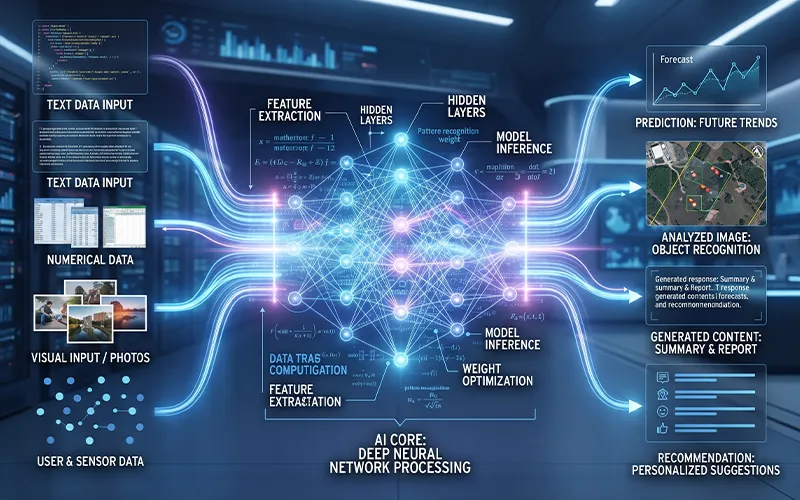
At a high level, how does AI work can be understood through four basic ideas: information goes into a system, the system processes that information, a trained or programmed model analyzes it, and the system produces an output.
Imagine an AI application that receives a photograph. The image is the input. The system converts and processes the visual information into a form that its model can analyze. The model then looks for patterns that are useful for the task. Finally, it produces an output, such as identifying an object in the photograph.
The same general idea can apply to text. If a person asks an AI chatbot a question, the text becomes input. The system processes the text, analyzes relationships between different parts of the input, and generates a response. The internal technology may be much more complicated than this simple description, but the input-processing-output idea provides a useful starting point.
In many modern AI applications, the model serves as the core component that processes information and produces useful results. A model is a mathematical and computational structure that has been created or trained to perform a particular task. During training, the model can adjust internal parameters based on examples. After training, it can use those learned patterns when it receives new information.
This means AI is not simply searching for an answer in a hidden database every time it receives a question. Different AI systems work differently, but many modern models calculate an output based on patterns and relationships learned during training.
The Main Parts of an AI System
An AI system usually contains several important components that work together. The first is data. Data provides the information from which a model may learn or with which it may operate. Depending on the application, data can include text, numbers, photographs, audio recordings, videos, sensor readings, or other information.
The second major component is an algorithm. An algorithm is a set of computational steps used to process information or solve a particular problem. In machine learning, algorithms help a model learn from data and adjust its parameters during training.
The third component is the model. The model represents patterns or relationships that can be used to produce an output. Different tasks require different model designs. A system for image recognition may use a computer vision model, while a language application may use a language model.
The fourth component is computing power. Training and operating modern AI models can require significant processing resources. Graphics processing units and other specialized hardware can perform large numbers of mathematical calculations efficiently.
Finally, AI development requires evaluation and human decisions. Developers need to decide what problem the system should solve, what data should be used, how results should be measured, and when a model is suitable for real-world use.
These components are connected rather than independent. Better hardware cannot automatically fix poor data, and a sophisticated model cannot guarantee correct results if the problem is poorly defined.
How Does AI Work Step by Step?
A useful explanation of how does AI work is to look at the complete development process from beginning to end. Although real projects can contain many additional stages, the following steps provide a clear overview.
Step 1: Define the Problem
Before collecting data, developers need to understand what the AI system is expected to do. The goal could be detecting spam, recognizing objects, predicting demand, translating text, recommending products, or generating content.
A clearly defined problem helps determine what type of data and model will be needed.
Step 2: Collect Data
The next stage involves collecting relevant information. A speech recognition system may require audio recordings and their corresponding text. A vision system may require images. A forecasting system may need historical measurements.
The data must be relevant to the task. Simply collecting a huge amount of information does not guarantee a useful AI model.
Step 3: Prepare the Data
Raw data often contains errors, missing information, duplicates, inconsistent formats, or other problems. Developers may clean and organize the information before training.
Images may need resizing or labeling. Text may need to be converted into a form that the model can process. Numerical information may need appropriate preparation as well.
Step 4: Choose a Model
Developers select a model that fits the problem. Different tasks require different approaches. Some problems can be handled with relatively simple machine learning models, while others require large neural networks or specialized architectures.
Step 5: Train the Model
During training, the model processes examples and produces predictions. The training system measures how close those predictions are to the desired results and adjusts internal parameters.
This process can happen many times. With enough suitable training data and appropriate optimization, the model can learn increasingly useful patterns.
Step 6: Validate and Test
A model needs to be evaluated using information that can show whether it works beyond the examples used for training. Developers can measure different performance indicators depending on the task.
Testing is important because a model might appear successful during training but perform poorly on unfamiliar information.
Step 7: Deploy the System
After appropriate testing, the model can be integrated into an application or service. Users can then provide inputs and receive outputs from the AI system.
Step 8: Monitor and Improve
AI systems may need monitoring after deployment. Real-world conditions can change, and new types of information can appear. Developers may need to update the model, improve data, adjust the system, or retrain it when necessary.
How Machine Learning Helps AI Learn
Machine learning is one of the most important approaches used to create modern AI systems. Instead of manually writing every rule, developers provide data and use algorithms that allow a model to discover useful relationships within that data.
There are several major types of machine learning. Supervised learning uses labeled examples. For instance, a system may receive photographs labeled as “car” or “bicycle” and learn to distinguish between them.
Unsupervised learning works with data that does not necessarily have predefined labels. The system can search for patterns, groups, or structures within the information. This can be useful for discovering customer groups or unusual patterns in datasets.
Reinforcement learning uses a different approach. An agent interacts with an environment and receives feedback based on its actions. Over time, it can learn strategies that improve its results according to the defined reward system.
These methods can be used separately or combined with other techniques. The right approach depends on the problem, available data, desired output, and system requirements.
How Neural Networks Process Information
Neural networks are mathematical models made from connected processing units arranged into layers. They are loosely inspired by the concept of neurons in biological brains, but they should not be considered digital copies of human brains.
A basic neural network can contain an input layer, hidden layers, and an output layer. Information enters through the input layer and passes through mathematical operations in the internal layers before reaching the output.
Connections between these units have numerical weights. During training, the model adjusts these weights so that its output becomes more useful for the task.
Deep learning uses neural networks with multiple layers. These deeper networks can learn complicated representations from large datasets. They have become especially important for image recognition, speech processing, natural language applications, and generative AI.
For example, a vision model may learn simple visual patterns in earlier layers and combine those patterns into more complex features in later layers. The exact behavior depends on the model architecture and training process.
How Does AI Work Scientifically?
To understand how does AI work at a deeper level, it is useful to look at the scientific foundations behind it. Modern AI depends on areas such as mathematics, statistics, probability, optimization, and computer science.
A model contains parameters that influence its predictions. During training, an error or loss value can measure how different the model’s prediction is from the desired result.
An optimization method then changes the parameters in a direction that can reduce this error. This process may be repeated across many training examples.
Probability is also important because AI systems often deal with uncertainty. A model may calculate the likelihood of different possible outputs instead of treating every result as absolutely certain.
Statistics helps developers understand patterns in data and evaluate model performance. Mathematics provides the operations used inside models, while computer science provides the algorithms and infrastructure needed to train and operate them.
This scientific foundation is one reason modern AI requires substantial computing resources. Large models can perform enormous numbers of mathematical operations during both training and use.
How Does AI Work With Photos?
When discussing how does AI work with photos, the main technology involved is often called computer vision. Computer vision allows computers to analyze visual information and identify patterns within images or video.
An image contains a large amount of numerical information representing pixels. An AI model can process these values and learn relationships between visual features.
For example, an image classification system can be trained to identify different types of objects. An object detection system goes further by identifying objects and their locations within an image.
Face recognition systems can analyze facial features and compare them with patterns learned by the model. Smartphone cameras can also use AI-based techniques for scene detection, image enhancement, autofocus, portrait effects, and other features.
AI can also be used for image generation and editing. Generative models can learn visual patterns from large datasets and create new images based on an input or description. Image editing systems can similarly use learned patterns to modify or enhance parts of a photograph.
How AI Understands Text and Human Language
Human language is complex because the same word can have different meanings depending on context. AI systems designed to process language therefore need methods for representing and analyzing relationships between pieces of text.
Natural Language Processing, or NLP, is a field that focuses on enabling computers to work with human language. Applications include translation, summarization, sentiment analysis, search, speech systems, and chatbots.
Modern language models often divide text into smaller units called tokens. These tokens are converted into numerical representations that allow the model to perform mathematical operations on them.
During training, the model learns patterns and relationships from large amounts of language data. These learned relationships can help it generate text, answer questions, summarize information, or perform other language-related tasks.
However, language generation is not the same as human understanding. The system operates through mathematical representations and learned patterns. This is one reason a language model can sometimes generate a fluent response that contains incorrect information.
How Does AI Work in Healthcare?
The use of AI in healthcare is growing across research, medical imaging, administration, and other areas. How does AI work in healthcare depends on the specific application and the type of information being analyzed.
Computer vision models can analyze medical images and identify patterns that may require further review. Machine learning systems can also process large datasets for research and help researchers investigate relationships between different variables.
AI can assist with administrative work as well. Systems may help organize documents, summarize information, or automate repetitive processes, depending on the application.
Another area of research is drug discovery. AI models can analyze large amounts of biological and chemical information to help researchers identify promising possibilities for further investigation.
Healthcare AI requires careful testing and professional oversight. A model’s output should not automatically be treated as a medical diagnosis or final decision. Privacy, security, validation, and responsible use are especially important because healthcare information can be highly sensitive.
How Does AI Work With Water?
The question how does AI work with water is becoming increasingly relevant as organizations look for better ways to manage water resources.
Water systems can generate large amounts of information through sensors, meters, weather data, infrastructure records, and consumption measurements. AI models can analyze these datasets to identify patterns and support operational decisions.
For example, an unusual change in pipeline pressure may indicate a possible leak. A monitoring system can compare current readings with normal patterns and alert operators when something appears unusual.
AI can also help estimate water demand. Historical consumption, weather conditions, seasonal patterns, and other variables can be analyzed to support planning.
Agriculture provides another application. Information about soil conditions, rainfall, temperature, and crop requirements can help support irrigation decisions. AI does not replace the physical water system, but it can help people analyze information from that system more efficiently.
How Generative AI Creates New Content
Generative AI is a category of AI designed to produce new content. Depending on the model, it can generate text, images, audio, video, code, or other forms of content.
Instead of only classifying existing information, a generative system learns patterns that can be used to create new outputs. Large language models, for example, can generate text based on the input provided by a user.
Image-generation models can create visual content based on text instructions or other forms of input. Audio systems can generate speech or other sounds, while some models can create or transform video.
Generative AI does not simply copy a single training example every time it creates content. The generation process uses mathematical representations and learned patterns to produce an output based on the model and input.
This technology has created new possibilities for content creation, software development, education, design, research, and many other fields, while also creating questions about accuracy, copyright, privacy, and responsible use.
How AI Works in Everyday Technology
Many people interact with AI without thinking about it as AI. Smartphones can use intelligent systems for face recognition, camera improvements, keyboard suggestions, speech recognition, and other features.
Search engines use complex systems to understand queries and organize information. Social media platforms can use recommendation models to select content for users. Streaming services can recommend movies, programs, or music based on patterns in available data.
Navigation applications can analyze traffic information and other data to support route planning. Online stores can use recommendation systems to suggest products.
Email applications can identify potential spam or suspicious messages. Smart devices can process voice commands and respond to users.
These applications demonstrate that AI is not limited to robots or chatbots. It can be built into ordinary software and devices that people use every day.
How AI Is Evaluated and Improved
After a model has been trained, developers need to determine whether it performs its intended task correctly. The evaluation method depends on the application.
The way an AI model is evaluated depends on what it is designed to do. Classification models can be checked by comparing their predicted categories with the correct ones. Prediction models can be assessed by looking at how closely their estimated results match real-world values. For generative AI, evaluation may focus on factors such as output quality, accuracy, reliability, and safety.
AI models can also be monitored after deployment. Real-world data may differ from the information used during training. User behavior can change, new situations can appear, and previously uncommon cases can become more frequent.
Developers may improve a system by collecting better data, changing the model, adjusting training methods, adding safety measures, or retraining the system.
Human feedback can also play an important role in some AI applications. People can evaluate outputs and provide information that helps developers understand where a system performs well or where it needs improvement.
Limitations and Challenges of AI
AI can perform impressive tasks, but it has important limitations. One major issue is that a model can produce incorrect results. A system may perform well on common examples but struggle with unusual situations that are not well represented in its training information.
Data quality is another challenge. If training data contains errors or unwanted bias, the resulting model may learn patterns that create unfair or unreliable results.
Privacy is also important. AI systems may process large amounts of information, so organizations need appropriate methods for protecting sensitive data.
Security is another concern. AI systems can be attacked, manipulated, or misused depending on their design and application.
AI can also require substantial computing resources, particularly during the training of very large models. This can increase costs and energy consumption.
For important decisions, human oversight remains valuable. AI should be used in ways that match the risks of the task, and users should understand that an AI-generated result is not automatically correct.
The Future of Artificial Intelligence
Artificial Intelligence is likely to become more deeply integrated into software and physical systems. Instead of using AI only through separate applications, people may increasingly find intelligent features inside tools they already use.
Healthcare research may continue using AI to analyze large datasets. Education platforms may use AI to provide personalized learning support. Businesses may use AI to automate repetitive processes and analyze information.
Robotics is another important area. AI can help robots interpret sensor information and respond to changing environments. In transportation, AI may support driver assistance, traffic analysis, and other systems.
Smaller and more efficient models may also become increasingly important. Not every AI task requires a huge model. Some applications may benefit from models that can operate directly on phones, computers, vehicles, cameras, or other devices.
The future of AI will depend not only on making models more powerful but also on making them more reliable, efficient, secure, transparent, and responsible.
Frequently Asked Questions
1. How does AI learn from data?
AI can learn from data by processing examples during training. The model compares its predictions with expected results and adjusts internal parameters to reduce errors. Repeating this process helps the model learn patterns that can be used with new information.
2. How does AI work with photos?
AI can process the numerical information contained in images and learn visual patterns from examples. Computer vision models can classify objects, detect objects, recognize faces, enhance images, and perform other visual tasks.
3. How does AI work in healthcare?
AI can analyze medical images, process large datasets, support research, assist with administrative tasks, and help identify patterns. Healthcare applications require careful testing, privacy protection, and professional oversight.
4. Can AI make mistakes?
Yes. AI can produce incorrect results because of poor data, unusual inputs, model limitations, bias, or situations that are different from its training environment. AI output should therefore be evaluated according to the importance of the task.
5. What is machine learning in AI?
Machine learning is an approach within AI that allows models to learn patterns from data. Instead of manually programming every possible situation, developers train a model using examples and algorithms.
6. What is a neural network?
A neural network is a mathematical model made from connected layers that process information. During training, its parameters are adjusted so that the model can become better at a particular task.
7. Can AI create new content?
Yes. Generative AI systems can create text, images, audio, video, code, and other types of content. They use patterns learned during training to generate new outputs based on user inputs or other conditions.
8. Will AI replace humans completely?
AI can automate or assist with many tasks, but it does not automatically replace every human role. Its capabilities depend on the system, task, environment, data, and level of human involvement. Many applications are designed to support people rather than operate independently.
Conclusion
Artificial Intelligence is a broad technology that combines data, algorithms, mathematical models, software, and computing power to perform tasks that can involve prediction, recognition, analysis, generation, or decision support.
The easiest way to understand how does AI work is to look at the complete process rather than focusing on one technology. A problem is first defined, suitable information is collected and prepared, a model is selected and trained, the results are tested, and the system is eventually used in a real application.
Machine learning allows many AI systems to learn useful patterns from examples. Neural networks provide a powerful way to process complex information, while computer vision helps machines work with images and video. Natural language technologies allow AI systems to process and generate human language. Generative AI extends these capabilities by creating new text, images, audio, video, and other content.
AI is already present in everyday technology and is being explored in areas such as healthcare, water management, agriculture, transportation, education, and scientific research. At the same time, AI has limitations involving accuracy, data quality, privacy, security, bias, cost, and responsible use.
Understanding these fundamentals makes AI less mysterious. It is not magic and does not work through a single method. It is a collection of technologies that use data, mathematics, algorithms, and computing systems to find patterns and produce useful outputs.
If you want to read more interesting and detailed guides, visit EmbossitWorld now. You’ll find useful Information, and a lot of practical information. Don’t miss out.




Add comment