
Introduction
AR and VR are often discussed together, but they are built around very different experiences. One adds digital information to the world you already see, while the other creates a computer-generated environment that can replace much of your physical surroundings. That difference affects how the technologies are designed, what hardware they need, where they are useful, and which one makes more sense for a particular person or business.
The easiest way to understand AR vs VR is to stop thinking of AR and VR as competing versions of the same product. They solve different problems. AR can be useful when you still need to see your room, street, workplace, or other real-world surroundings. VR becomes more useful when the goal is to place your attention inside a controlled digital space. Once that basic idea is clear, the differences in glasses, headsets, applications, costs, and future possibilities become much easier to understand.
What Is AR?
Augmented reality, usually called AR, places digital content over a view of the physical world. The real environment remains visible, while software adds elements such as labels, arrows, 3D objects, notifications, instructions, or visual effects. A phone camera can provide an AR experience, but specialized glasses can make digital information feel more naturally connected to the user’s surroundings.
For example, an AR navigation application may show directional arrows on a street view. A furniture application can place a virtual sofa inside a camera view so that a shopper can judge its size and position. In an industrial setting, AR can display repair instructions near a machine while the technician continues looking at the actual equipment.
AR is therefore less about escaping reality and more about enhancing it. Its strength is context. The digital layer can respond to what is around the user and provide information at the moment it is useful.
What Is VR?
Virtual reality, or VR, creates an immersive digital environment that surrounds the user. A VR headset normally covers the user’s field of view and uses displays, sensors, and software to create the feeling of being inside a simulated space. Depending on the system, users may look around, move their heads, use controllers, interact with virtual objects, and sometimes move around a tracked physical area.
A VR experience could place someone inside a game, training simulation, virtual classroom, architectural model, museum, or meeting environment. Because the physical world is largely hidden, designers have much more control over what the user sees and hears.
The biggest strength of VR is immersion. Instead of placing a digital object into the user’s environment, it can create an entirely different environment. This makes VR particularly interesting for situations where realism, concentration, practice, or presence matters more than maintaining a continuous view of the real world.
AR vs VR vs MR
Mixed reality, or MR, sits between traditional AR and fully immersive VR in many modern discussions. The term can describe experiences where digital objects are not merely displayed over the real world but can also appear to understand and interact with the physical environment.
Imagine placing a virtual table in a real room and having it remain fixed to the floor as you walk around it. A more advanced system might allow a virtual character to appear behind a real wall, making the wall behave like an actual boundary from the system’s perspective.
This is why ar vs vr vs mr is useful as a search phrase but can be confusing as a technical comparison. AR is a broad concept, MR is often treated as a more spatially aware form of blending digital and physical elements, and VR focuses on immersive digital environments. In practice, the boundaries can overlap depending on the device and the company describing its platform.
AR vs VR vs XR Explained
XR, or extended reality, is an umbrella term that can cover AR, VR, MR, and related immersive technologies. It is often used when discussing the wider ecosystem rather than one specific experience.
The relationship can be understood as a technology family. AR enhances the physical environment, VR immerses the user in a digital environment, and MR emphasizes interaction between digital content and the physical world. XR provides a broader label for this group of experiences.
This is why searches such as ar vs vr vs xr and xr vs ar vs vr often produce overlapping explanations. XR is not necessarily another headset mode that must be chosen instead of AR or VR. It is usually a broader category used to describe technologies that extend or alter how people experience digital and physical environments.
AR vs VR Glasses: How the Hardware Differs
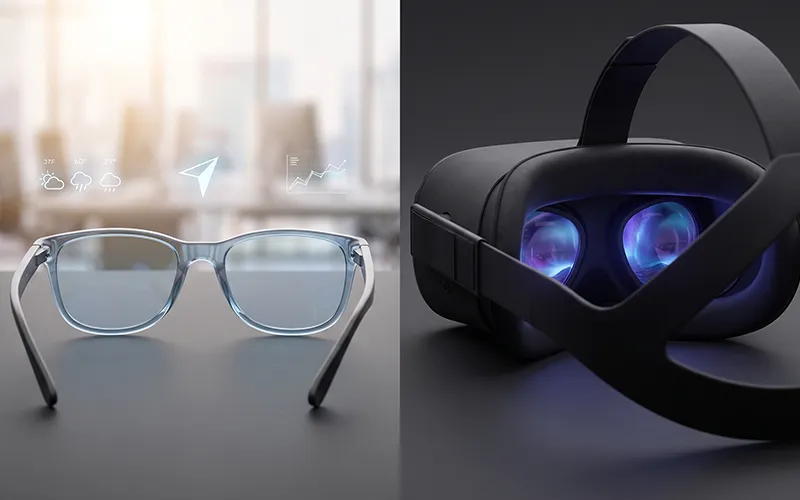
When comparing AR vs VR glasses, the biggest difference comes down to how each device interacts with the world around you. AR glasses are built to keep your surroundings visible while adding digital elements to your field of view. Depending on the device, this can be achieved through transparent displays, cameras, depth sensors, and other tracking technology.
The idea behind AR hardware is to blend digital information with the physical environment. For example, a user might see directions, notifications, 3D objects, or other visual information without losing sight of the real world. This makes AR glasses useful for situations where digital content needs to work alongside the user’s surroundings.
VR headsets use displays positioned close to the user’s eyes and typically create separate images for each eye to produce depth. They also rely on tracking systems to understand head movement and, on many modern devices, hand or controller movement.
The hardware difference reflects the experience. AR glasses need to balance visibility, brightness, field of view, weight, battery life, and comfortable everyday wear. VR devices can prioritize immersion and visual coverage but must also deal with weight, heat, motion tracking, and the need to keep users safe while they cannot fully see their surroundings.
How AR and VR Track the User
Tracking is one of the most important parts of immersive technology. AR systems may use cameras and sensors to understand surfaces, movement, depth, and the position of digital objects. This allows a virtual object to remain anchored to a table or floor instead of appearing to float randomly.
VR systems also track movement, but their primary objective is to update the virtual environment according to the user’s position and orientation. Head movement is especially important because even a small delay can make an experience feel unnatural or uncomfortable.
Modern systems may combine cameras, inertial sensors, depth information, and software algorithms. The exact technology varies by device, but accurate tracking is essential for both categories because the illusion becomes weaker when digital content fails to respond naturally to movement.
Which Technology Is Better?
When people ask AR vs VR which is better, the honest answer is that there is no universal winner. The better option depends on the experience you want to create.
Choose AR when the real world is important to the task. It makes sense when users need to look at physical objects, receive contextual information, follow visual instructions, or see digital content in a real location.
Choose VR when immersion is the priority. It makes sense when users need a simulation, a controlled digital environment, an immersive game, or a virtual space that does not need to match the physical room.
Another important factor is convenience. AR can be easier to use in everyday situations because users do not necessarily need to leave the real environment. VR can require a dedicated play or work area and a stronger focus on the virtual experience.
The Cost and Accessibility Question
Price is not simply a matter of buying a headset. The total cost can include the device, computer or console requirements, software, accessories, replacement parts, storage, and training.
AR experiences delivered through smartphones can have a relatively low entry barrier because many people already own a compatible device. Specialized AR glasses may be more expensive and can have additional limitations related to battery life, field of view, and comfort.
VR also ranges from relatively accessible standalone headsets to more advanced systems designed for demanding applications. A professional training or visualization setup can cost much more than a consumer gaming device.
For businesses, the important question is not only hardware price but return on investment. A technology that reduces training time, improves product visualization, or helps prevent mistakes may justify a higher initial cost.
Comfort, Safety, and Practical Limitations
Comfort is one of the less glamorous but more important parts of immersive technology. A device can have impressive specifications and still be frustrating if it feels heavy, gets warm, has poor battery life, or causes visual discomfort.
VR requires particular attention to the physical environment because users may not see nearby furniture, walls, pets, or other people clearly. Safe play areas, appropriate settings, and sensible usage habits are important.
AR has a different challenge: the digital information must remain readable without becoming distracting. Too many floating labels, notifications, or animated objects can make the experience harder to understand instead of easier.
Good immersive technology should disappear into the task as much as possible. Users should understand what to do without constantly thinking about the device itself.
AR vs VR Images and Diagrams
If you are creating an AR vs VR diagram for an article, presentation, or classroom lesson, keep the visual simple. A useful diagram can show a person looking through AR glasses with the physical environment still visible and digital labels placed over it. Next to that, show a VR headset user surrounded by a fully digital scene.
AR vs VR images should also communicate the difference in one glance. Avoid diagrams that contain too many technical components. The strongest educational image usually focuses on the user’s field of view, the physical environment, and the digital layer.
For websites, images should have descriptive alt text and should support the explanation rather than repeat every sentence. A clean comparison graphic can make a technical article easier to understand, especially for readers who are new to immersive technologies.
AR vs VR and Mixed Reality in Business
Businesses are increasingly interested in immersive technologies because they can connect digital information with real operations or create repeatable virtual experiences.
Retail companies can use AR for product previews. Manufacturers can use AR-style visual guidance for assembly and maintenance. Architects can use immersive visualization to review spaces before they are built. Training organizations can use VR to create controlled practice environments.
Mixed reality can be useful when digital objects need to behave as if they belong in the physical environment. This can support collaborative design, industrial visualization, education, and other spatial tasks.
The most important business question is not which technology sounds more advanced. It is whether the technology solves a measurable problem better than an ordinary screen, video, mobile application, or traditional training method.
AR vs VR for Gaming and Entertainment
Gaming is one of the most visible areas for VR because the technology can make players feel surrounded by the game world. Head movement, hand tracking, spatial audio, and interactive environments can make the experience significantly different from playing on a conventional screen.
AR gaming takes another approach. It can turn familiar places into part of the experience, allowing digital characters or objects to appear alongside the physical environment.
Entertainment can also use immersive technology for virtual concerts, interactive storytelling, tourism, museums, and other experiences. The choice depends on whether the creator wants the audience to remain connected to the real world or enter a separate digital setting.
What About AR vs VR Porn?
Searches for ar vs vr porn exist because adult entertainment companies have experimented with immersive formats. From a technology perspective, the same basic distinction still applies: AR-style experiences can add digital elements to a real environment, while VR can create a more immersive simulated environment.
For a general technology article, it is better to treat this as a content-category example rather than a reason to choose one technology. Privacy, age restrictions, consent, data handling, and responsible use are important considerations for any adult digital service.
The Future of Immersive Technology
The future is unlikely to be a simple situation where one technology replaces the other. Instead, AR, VR, MR, and other XR experiences are likely to overlap more as hardware becomes smaller, sensors become more capable, and software becomes better at understanding physical spaces.
One major direction is the move toward more natural interaction. Voice, eye tracking, hand gestures, spatial mapping, and contextual computing can reduce the need for traditional controllers and menus.
Another important trend is improving comfort. Smaller devices, better displays, more efficient processors, lighter batteries, and improved optical systems could make immersive technology easier to use for longer periods.
AI may also make these systems more useful by helping them understand scenes, objects, language, and user intent. Instead of simply displaying a digital object, future systems may be able to understand why the user needs it and present information at the appropriate moment.
FAQs
- What is the main difference between AR and VR?
AR adds digital content to the physical environment, while VR creates a digital environment that surrounds the user. AR keeps the real world visible, whereas VR usually makes the virtual world the main visual experience.
- Is AR better than VR?
Neither is always better. AR is often better for navigation, product visualization, workplace guidance, and tasks involving real objects. VR is often better for gaming, simulation, immersive training, and virtual experiences.
- What is the difference between AR, VR, and MR?
AR adds digital information to the real world, VR creates an immersive digital environment, and MR generally refers to experiences where digital objects can interact more naturally with physical surroundings. The exact meaning of MR can vary by platform.
- What does XR mean?
XR stands for extended reality. It is commonly used as an umbrella term covering AR, VR, MR, and related immersive technologies. It is useful when discussing the broader ecosystem rather than one specific experience.
- Are AR glasses the same as VR headsets?
No. AR glasses are designed to maintain awareness of the physical environment while presenting digital information. VR headsets are designed primarily to create an immersive digital view. Their displays, sensors, tracking systems, and intended use can therefore be quite different.
- Which technology is better for gaming?
VR is usually the stronger choice when the goal is deep immersion and interaction inside a digital game world. AR can be more interesting when the game is designed around the player’s real surroundings.
- Can AR and VR be used together?
Yes. Some experiences can combine elements of both approaches. A system may use cameras and spatial understanding to keep track of the physical environment while also presenting highly immersive digital content. This overlap is one reason XR has become an important industry term.
- Will AR or VR replace normal screens?
It is unlikely that immersive devices will completely replace phones, laptops, televisions, and other screens in every situation. Traditional screens remain convenient for many tasks. AR and VR are more likely to become additional ways of accessing information when their unique strengths provide a clear advantage.
Conclusion
AR and VR represent two different approaches to changing the way people experience digital information. AR keeps the physical world in the picture and adds useful digital layers, while VR creates a separate immersive environment. MR can connect digital objects more closely with physical surroundings, and XR provides a broad term for this larger family of technologies.
The most useful way to compare them is to focus on the job they need to perform. If you need real-world awareness, contextual information, or digital guidance around physical objects, AR may be the better fit. If you need immersion, simulation, or a fully controlled digital environment, VR can offer a stronger solution.
As hardware and software continue to develop, the line between these categories will become less obvious. What matters most will be the quality of the experience, the usefulness of the application, and how naturally people can interact with digital content. Rather than asking which technology is always better, ask which one is better for the specific problem you want to solve.
If you want to read more interesting and detailed guides, visit EmbossitWorld now. You’ll find useful Information, and a lot of practical information. Don’t miss out.




Add comment