
Introduction
Social media has become an integral part of everyday life in today’s digital world. People use platforms such as Facebook, Instagram, TikTok, YouTube, LinkedIn, X, and other online communities to communicate, share content, learn new things, promote businesses, follow trends, and stay connected with friends and family. For many people, checking social media is now part of their daily routine. However, while these platforms offer many useful opportunities, they can also create problems when they are used without limits.
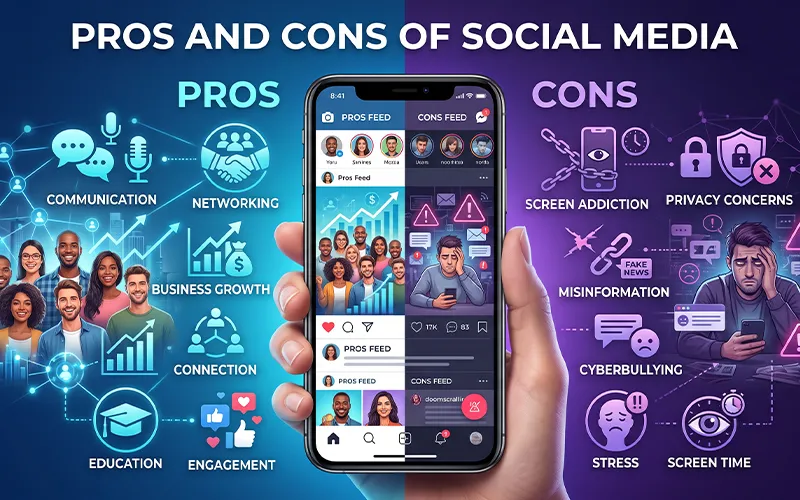
Understanding the pros and cons of social media is important because social media itself is neither completely good nor completely bad. Its effects often depend on how people use it, how much time they spend online, what type of content they consume, and how platforms manage information and user behavior. Social media can help a student discover educational resources, help a small business reach new customers, or help people stay connected across long distances. At the same time, excessive use can contribute to distraction, misinformation, privacy concerns, cyberbullying, and other challenges.
This guide explains the major advantages and disadvantages of social media in simple terms. It also looks at social media advertising, children and students, healthcare, content moderation, regulation, algorithms, and law enforcement so you can understand the wider impact of these platforms.
Major Benefits of Social Media
- Easy Communication
One of the biggest benefits of social media is the ability to communicate quickly. People can send messages, share photos, make video calls, and participate in group discussions without worrying about geographical distance. Families and friends living in different cities or countries can remain connected through regular online interaction.
Businesses also use social platforms to communicate with customers. Instead of relying only on phone calls or traditional advertising, companies can answer questions, provide updates, collect feedback, and build relationships directly with their audiences.
- Access to Information
Social media has made information easier to discover. News updates, educational videos, expert discussions, tutorials, industry announcements, and public information can reach users within minutes.
Students can discover study resources, professionals can follow developments in their industries, and ordinary users can learn practical skills from educational creators. However, easy access does not automatically mean that every piece of information is accurate. Users still need to check reliable sources before accepting important claims as facts.
- Educational Opportunities
Social media can serve as a casual space where people learn, share knowledge, and discover new ideasTeachers, universities, professionals, organizations, and educational creators share explanations, demonstrations, guides, and discussions across different platforms.
For students, this can make difficult subjects easier to understand because they can find different explanations of the same topic. Social media can also help learners discover scholarships, courses, workshops, communities, and career opportunities.
- Business Growth and Marketing
Businesses now use social media to connect with customers in faster and more direct ways. Even a small company can create a page, publish content, communicate with potential buyers, and build a recognizable brand without depending entirely on traditional media.
Businesses can use social platforms to showcase products, publish customer reviews, answer questions, announce promotions, and understand audience interests. This makes social media especially valuable for startups and small businesses that may have limited marketing budgets.
- Networking and Career Opportunities
Professional networking is another important advantage. People can connect with employers, industry professionals, recruiters, business owners, and other specialists. Sharing useful work, achievements, projects, and professional knowledge can help build an online reputation.
For job seekers, social media can provide access to vacancies and professional communities that may not be discovered through traditional job searches alone.
- Community and Support
Social platforms allow people with similar interests or experiences to find one another. Communities can be built around education, hobbies, professional interests, sports, entertainment, local activities, and many other subjects.
These communities can provide advice, encouragement, ideas, and opportunities for collaboration. Someone who feels isolated in their local environment may find people with similar interests online.
- Entertainment and Creativity
Social media provides an enormous amount of entertainment. Users can watch videos, discover music, follow creators, explore photography, read discussions, and participate in trends.
It also gives creative people a place to showcase their work. Photographers, writers, designers, musicians, filmmakers, and other creators can build audiences without depending entirely on traditional media companies.
Common Disadvantages of Social Media
- Excessive Use and Distraction
One of the biggest problems associated with social media is excessive use. Platforms are designed to encourage continued interaction through notifications, recommendations, short videos, and constantly updated feeds.
This can make it difficult for users to stop scrolling. Students may lose study time, employees may become distracted at work, and people may spend less time on offline activities. A simple way to reduce this problem is to set time limits and turn off unnecessary notifications.
- Privacy Concerns
Privacy is another major issue. Users often share photos, locations, personal opinions, contact information, professional details, and other information online. Depending on platform settings and user behavior, some of this information may become available to a much wider audience than expected.
People should review privacy settings, avoid sharing sensitive information publicly, use strong passwords, and be careful about unknown links or accounts.
- Misinformation and Fake News
Unverified information can travel rapidly across social media network. A misleading post can be shared thousands of times before users have an opportunity to verify it.
This is especially concerning when information involves health, finance, politics, emergencies, or public safety. Users should check the original source, compare information with trustworthy publications, and avoid sharing sensational claims simply because they appear convincing.
- Cyberbullying and Online Harassment
Social media can sometimes become a place for bullying, harassment, insults, threats, or public humiliation. Because users can communicate from behind screens, some people may behave more aggressively online than they would in person.
Young users can be particularly vulnerable to these experiences. Reporting harmful behavior, blocking abusive accounts, saving evidence when necessary, and seeking help from trusted adults or responsible authorities can be important steps.
- Unrealistic Comparisons
Social media often shows carefully selected versions of people’s lives. Users may see attractive photographs, successful careers, expensive purchases, vacations, or impressive achievements without seeing the difficulties behind them.
Constant comparison can create unrealistic expectations. Remembering that online content is often edited, selected, or presented for public attention can help users maintain a more balanced perspective.
- Reduced Productivity
Social media can interfere with work and study when used at inappropriate times. Constant notifications can break concentration, while frequent checking can make simple tasks take longer.
Creating specific periods for social media and keeping distracting apps away during important work can help improve focus.
Pros and Cons of Social Media Advertising
Social media advertising has become an important part of digital marketing. One of its biggest advantages is targeting. Businesses can often create campaigns designed for specific audiences based on factors such as interests, demographics, location, or online behavior.
Advertising can also be relatively flexible. Businesses can test different messages, images, videos, and offers and monitor how audiences respond. This can make it easier to adjust campaigns than some traditional advertising methods.
However, there are disadvantages as well. Competition can be intense, and advertising costs can increase when many businesses target the same audience. Poorly designed advertisements may be ignored, while excessive advertising can annoy users.
Another concern is dependence on platform rules and algorithms. A business can build an audience on a social platform but still have limited control over how many followers actually see each post or advertisement.
Pros and Cons of Social Media for Kids
The pros and cons of social media for kids require special attention because children may not have the experience needed to recognize online risks.
Social media can provide educational content, creative activities, communication with friends, and communities based on positive interests. Children can learn new skills, discover educational resources, and explore creative hobbies.
However, risks can include cyberbullying, inappropriate content, privacy problems, excessive screen time, online strangers, and exposure to misleading information. Children may also find it difficult to understand how permanent online posts can become.
Parents and guardians can reduce these risks by discussing online safety, using appropriate privacy controls, encouraging healthy screen-time habits, and teaching children to think carefully before sharing information.
Pros and Cons of Social Media in Healthcare
Social media has created new opportunities in healthcare. Medical organizations and professionals can use social platforms to share general health education, public awareness campaigns, service updates, and information about healthy habits.
Patients can also find communities where people discuss experiences and support one another. Healthcare organizations may use social media to communicate during public health campaigns or emergencies.
However, the pros and cons of social media in healthcare must be considered carefully. Medical misinformation can spread quickly, and users may mistake general online information for personalized medical advice. Privacy is another important concern because health-related information can be sensitive.
For serious medical decisions, people should rely on qualified healthcare professionals and trustworthy medical sources rather than treating social media posts as a substitute for professional care.
Pros and Cons of Social Media Content Moderation
Content moderation is the process of identifying and managing material that violates a platform’s rules. It can help reduce harmful content such as scams, threats, harassment, graphic material, and certain forms of abusive behavior.
The main advantage is creating a safer environment for users. Without moderation, harmful content could become much more difficult to control on large platforms.
However, the pros and cons of social media content moderation include difficult questions about fairness and freedom of expression. Platforms must decide which content violates their rules, and mistakes can happen. Legitimate content may sometimes be removed, while harmful content may sometimes remain online.
Effective moderation therefore requires clear rules, consistent enforcement, appeals processes, and responsible use of automated and human review systems.
Pros and Cons of Social Media Regulation
Governments and policymakers around the world have discussed different ways to regulate social media. Regulation may focus on privacy, child safety, harmful content, advertising, transparency, competition, or platform responsibility.
The potential benefit is stronger protection for users and greater accountability for large technology companies. Clear rules can encourage platforms to take issues such as privacy and safety more seriously.
At the same time, the pros and cons of social media regulation can be complicated. Poorly designed regulations may create unnecessary restrictions, increase compliance costs, or create uncertainty about online expression.
Good regulation needs to balance user protection, innovation, privacy, accountability, and legitimate freedom of expression.
Pros and Cons of Social Media Algorithms
Social media algorithms help platforms decide which posts, videos, advertisements, and recommendations users see. Their main advantage is personalization. Instead of showing every piece of content published on a platform, algorithms can prioritize material that may be relevant to individual users.
This can make social media more useful and entertaining. A person interested in cooking, for example, may receive more cooking-related content.
However, the pros and cons of social media algorithms deserve attention because algorithms can influence what people see and how long they remain on a platform. If systems prioritize highly engaging material, users may repeatedly encounter sensational or emotionally charged content.
Algorithms can also create information bubbles where users mainly see opinions similar to their own. Understanding that social media feeds are personalized can encourage people to actively seek different reliable perspectives.
Pros and Cons of Social Media in Law Enforcement
Social media can also be useful in law enforcement. Public posts may provide information about events, emergencies, missing people, public safety concerns, or criminal investigations. Law enforcement agencies may also use official social accounts to communicate warnings and updates with communities.
However, the pros and cons of social media in law enforcement include important concerns about privacy, accuracy, and the interpretation of online information. A social media post may be incomplete, misleading, edited, or taken out of context.
Responsible use requires appropriate procedures and careful verification rather than assuming that everything posted online is accurate evidence.
Frequently Asked Questions
1. What are the main pros and cons of social media?
The main benefits include communication, education, networking, entertainment, and business promotion. The main disadvantages include privacy concerns, misinformation, cyberbullying, distraction, and excessive use.
2. Is social media good or bad for students?
Social media can be helpful for students when used for learning, research, networking, and educational communities. However, excessive scrolling and notifications can distract students from their studies.
3. What are the pros and cons of social media advertising?
Social media advertising can help businesses reach targeted audiences, promote products, and measure campaign results. Its disadvantages include advertising costs, strong competition, changing algorithms, and dependence on platform policies.
4. What are the pros and cons of social media for kids?
Social media can help kids discover educational content, communicate with friends, and explore creative interests. However, children may face risks such as cyberbullying, privacy problems, inappropriate content, and excessive screen time.
5. Can social media affect mental well-being?
Yes, excessive or unhealthy social media use can contribute to stress, comparison, distraction, and negative online experiences. Using social media in moderation and taking regular breaks can encourage healthier habits.
6. How does social media spread misinformation?
Social media allows users to share content very quickly, so false or misleading information can reach large audiences before it is verified. Checking reliable sources before sharing information can help reduce the spread of misinformation.
7. Are social media algorithms helpful or harmful?
Algorithms can make feeds more personalized by showing users content related to their interests. However, they may also repeatedly promote highly engaging content and limit exposure to different viewpoints.
8. How can people use social media responsibly?
People can use social media responsibly by protecting their privacy, checking information before sharing it, limiting screen time, avoiding harmful interactions, using strong account security, and maintaining a healthy balance between online and offline activities.
Final Thoughts
The pros and cons of social media show why these platforms have become both valuable tools and serious sources of concern. Social media can connect people, support education, create business opportunities, encourage creativity, and provide access to information on a global scale. At the same time, privacy problems, misinformation, cyberbullying, excessive use, harmful content, and algorithmic influence can create real challenges.
The best approach is not necessarily to avoid social media completely. Instead, users should learn how these platforms work and develop responsible habits. Businesses should use advertising thoughtfully, parents should guide children, students should manage distractions, and all users should protect their personal information and verify important information.
Social media is ultimately a tool. Its impact depends greatly on how it is designed, managed, and used. With informed decisions and healthy boundaries, people can enjoy the benefits while reducing many of the disadvantages that come with modern social media use.





Add comment