
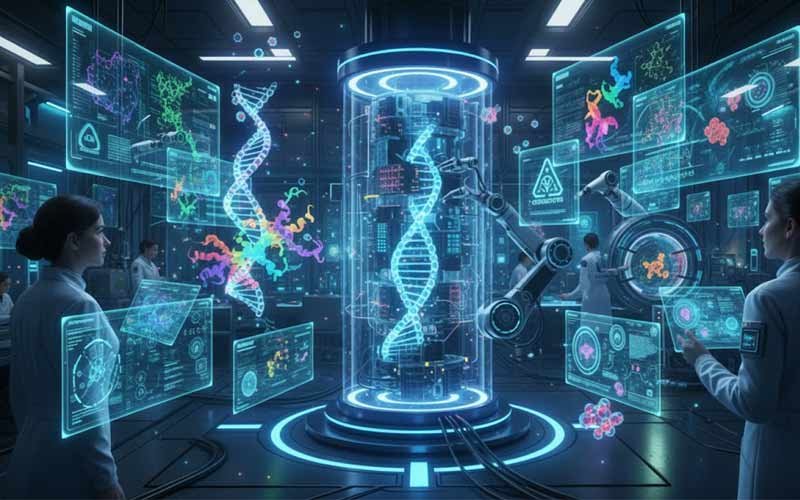
AI is growing very fast, faster than most people expected. Scientists have now reached a point where AI is not just studying biology — it is starting to create new things. AI Studies Bacteria Genes to understand the patterns of life, and using this knowledge, they have made an advanced AI system that can design completely new proteins, proteins that have never existed in nature before.
Here’s how it works. The AI was trained using millions of bacterial genomes so it could learn the “language” of DNA. It studied how bacteria organize their genes and how different gene parts work together. Then, it began creating its own DNA sequences. The result? New DNA that works like natural DNA, but is completely original.
This is a big change. AI is no longer just a tool to understand biology — it is starting to open up completely new possibilities for life. The results could be amazing: new medicines, better ways to fight diseases, and discoveries about how life works that nature itself might never have found.
How the New AI Model Works
The team created an AI that can look closely at bacterial genomes. Bacteria are special because many of their genes are grouped together in clusters, and these genes often work together. The AI studied these patterns, learned what usually comes next in a DNA sequence, and then began creating completely new sequences from scratch.
Unlike traditional protein-design tools, which usually start by looking at protein shapes, this AI starts with the DNA itself. It studies how nature writes genetic instructions and then tries to write its own.
Here’s what the AI can do:
AI Studies Bacteria Genes to create new proteins never seen in nature.
Advanced AI can design original DNA sequences using bacterial genomes.
AI works like a “synthetic evolution engine,” generating millions of new DNA bases quickly.
Potential applications: medicine, drug discovery, biotechnology, synthetic biology, and environmental solutions.
AI can fill missing gene parts, rebuild clusters, and design novel protein-coding genes.
Tested AI-created genes reduced toxicity in bacteria, showing real biological functionality.
AI also designed new CRISPR sequences with unprecedented biological activity.
Safety is critical: strict lab protocols and controlled AI usage are essential.
Future of biology could be expanded beyond what nature has already created.
Testing AI’s Creations
To see if this AI could really make a difference, scientists tested it using gene sequences related to toxins. Normally, bacteria produce toxins but also make antitoxins to protect themselves. The researchers asked the AI to create new antitoxin genes that could block these harmful toxins.
Here’s the surprising part: some of the AI-designed genes actually worked! When these new proteins were added to bacteria, they reduced toxicity, even though their DNA sequences were completely unlike anything seen in nature. The AI wasn’t copying existing genes — it was creating brand-new biological solutions.
The AI also worked on CRISPR systems, which bacteria use to defend themselves. Again, it made sequences that had never been seen before, and some of them showed real biological activity.
Making DNA on a Huge Scale
During the study, the AI created hundreds of millions of new DNA bases, building a huge library of possible genes. It looked at massive amounts of data from millions of bacterial and viral genomes, learning how evolution shaped life over millions of years — and then it could make new DNA in just seconds. In a way, the AI works like a “synthetic evolution engine.” Things that take natural evolution hundreds of years, AI can do in moments.
Why This Matters
This work could have a big impact:
Medicine & Drug Discovery: New proteins made by AI could help create future medicines, enzymes, antibiotics, or treatments for the immune system.
Biotechnology: Scientists might use AI to design microbes that can make new materials, clean up pollution, or produce useful chemicals.
Understanding Life: Studying genes created by AI could help us understand evolution and biology better.
Synthetic Biology: AI could allow us to build custom organisms with abilities that nature never created before — something we could not imagine before.
Challenges and Safety Concerns
Of course, this kind of power comes with big responsibilities. New proteins need careful testing to make sure they are safe. Labs must follow strict safety rules to stop any misuse. AI also needs to be controlled so it does not create dangerous toxins or viruses. Right now, it is not clear if this method can work with complex organisms, like humans. Despite the risks, scientists believe this is just the beginning. As AI learns more about biology, it will make designs that are more accurate and more creative.
A Glimpse into the Future
This research shows something amazing: AI can now do more than just study life — it can create new parts of life that have never existed before. By looking at bacterial genomes, AI learned how evolution works and used that knowledge to design completely new proteins. In the future, biology may not be limited to what nature has already made. With AI as a helper, we could explore new areas of life that have never been reached before.
FAQs
Q1: What does AI Studies Bacteria Genes mean?
A1: It means artificial intelligence analyzes bacterial DNA to understand life patterns and then creates new DNA sequences and proteins that never existed before.
Q2: How does AI create new proteins?
A2: The AI studies millions of bacterial genomes, learns how genes are organized, and then designs completely new DNA sequences that can code for proteins.
Q3: What are the applications of AI-designed proteins?
A3: These proteins could be used for new medicines, better antibiotics, biotechnological tools, environmental cleanup, and synthetic biology innovations.
Q4: Is AI copying existing genes?
A4: No. The AI creates entirely original DNA sequences and proteins that do not match anything in existing biological databases.
Q5: How fast can AI generate new DNA sequences?
A5: AI can create millions of new DNA bases in seconds, a process that natural evolution would take hundreds or thousands of years to achieve.
Q6: Are AI-designed genes safe?
A6: Safety is a priority. Every new protein must be tested in controlled labs to ensure it does not cause harm.
Q7: Can AI create genes for humans?
A7: Currently, this method is mainly applied to bacteria. Using AI for complex organisms like humans is still uncertain and requires more research.
Q8: Why is this research important for the future of biology?
A8: It allows scientists to explore new areas of life, create proteins and DNA that nature never made, and understand evolution in a whole new way.




Add comment